Film music contractor Sidney Sax discusses his part in facilitating Charles Gerhardt's 'Classic Film Scores' series.
For Fixer read Contractor. If you are still none the wiser, either term refers to a specialist member of the music profession.
Sidney Sax, a quiet spoken man, is probably the most widely-known fixer in British musical circles. With his wealth of experience, Sax is known for providing the right musician for the right job, to be at the right place at the right time.
Sax Sakanov
Sidney Sax is a violinist and recorded a number of solo pieces with orchestra for the Decca/London label. The company was happy with the performances but felt that a Russian name would be more suitable for the style and composition of the pieces. When this matter arose, the orchestra was on tour in Japan and discussion was held on the telephone. To satisfy the company, Sax suggested the name of his father, Josef Sakanov, which pleased them.
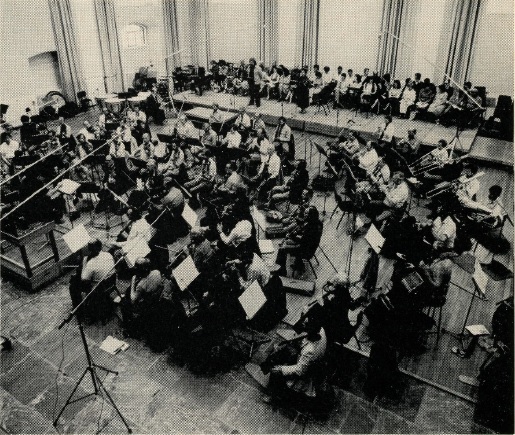
By 1970 record companies were seeking to give the orchestra due recognition and so the National Philharmonic Orchestra came into being. It is a freelance body of musicians working mainly in recording studios. Unlike many other orchestras, the N.P.O. is not funded or supported financially, and it is with pride that together they have always given of their best and continue to receive high praise for their work.
Opera
Sidney Sax’s work has given him many opportunities to meet and work with wonderful people in music. In the field of opera the National Philharmonic has recorded with Pavarotti, Joan Sutherland, Kiri Te Kanawa, Placido Domingo, Sir George Solti, Leopold Stokowski, James Levine, Lorin Maazel, and many others. The N.P.O. have made many recordings of ballet music with Richard Bonynge. At the request of Rudolph Nureyev, the N.P.O. was invited to appear at La Scala, Milan with his company.
The Stars
In light entertainment, including radio, television and recordings, Sax has provided musicians for such artists as Ella Fitzgerald, Nat King Cole, Frank Sinatra, Nelson Riddle, Ethel Mirman, Harry James, Eric Clapton, Queen, Pink Floyd and the Beatles.
Readers of Music from the Movies will be more than aware of the numerous films where he has provided the musicians to record the music. Sax has for many years been called upon by the finest film composers; Jerry Goldsmith (see MFTM#6), Henry Mancini, John Williams, Maurice Jarre, James Horner, Bernard Herrmann, Alex North and Miklós Rózsa. The wealth of talent that has come from America has enhanced the reputation of the orchestra as being one of the finest; the best sight readers and the quickest to respond to the full emotions of the music.
Sax is often asked “Which is the best score you have ever recorded?”. Sax invariably replies, “The one we are recording now”. Sax does however have many memories of some fine scores: “John Williams’s main theme for ‘Fiddler on the Roof’ played by Isaac Stern. The unforgettable music for the “Pink Panther” series by the tunesmith Henry Mancini. The utterly original scores of Bernard Herrmann, in particular the score for “Psycho”. The main theme for “Barry Lyndon” directed by Stanley Kubrick was performed by ten timpanists playing on twenty drums. The intellectual scores of Alex North; for example,
“Dragonslayer”. The scores of Jerry Goldsmith, every one different and entirely individual, including for us the first one, the elegant score for “The Blue Max”.
Charles Gerhardt had been visiting this country for a number of years as a record producer for RCA and Reader’s Digest. In 1965 he invited Sax to provide an orchestra having heard the good work he had done for other companies. This started an association which continues successfully to the present time. In the happy combination of musician, record producer, and film buff, Gerhardt decided to bring to light the great music scores composed by Max Steiner, Erich Korngold, Miklós Rózsa, Franz Waxman, Bernard Herrmann, and Alfred Newman for films made during the golden Hollywood era.
Classic Film Scores
Sax had been booking orchestras for world-renowned companies such as 20th Century Fox, Paramount, Warner Brothers, and MGM. As Sax explains, “This gave a wonderful opportunity to play the great scores of the masters. None of the music was in printed form and a great deal of work had to be done to make the parts both readable and playable. With the composers present in the studio, it gave added inspiration to all concerned to create music for The Classic Film Scores series”. Today, of course, they are still upheld as a paragon of style, production and performance.