Crescendo
Record producer Mark Banning discusses how his label has put out several "Star Trek" albums, and some of the costs and considerations involved.
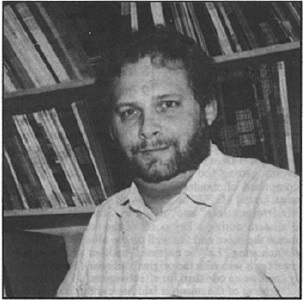
Without Varèse Sarabande (see last issue), a lot of soundtracks would not exist; but without GNP/Crescendo, and Mark Banning as one of its fearless leaders, a good number of nicely weird soundtracks would not exist.
Seeing the offices of GNP/Crescendo made me want at first to refer to the operation as ‘a rag-tag fugitive record label’. But that's not fair; it wouldn't fit even should GNP ever release an “Earth*Star Voyager” album, which considering their output would not surprise me. The lasting impression one gets of Mark Banning is that he is a big, enthusiastic fan of all this weird stuff and we're lucky to have him.
All of Hollywood lies between the Capitol Records tower and the Best Western Sunset Plaza (yes, a Best Western) where Crescendo has its small, informal, fannishly furnished offices. As the world’s only soundtrack/“Star Trek”/sci-fi/jazz/Dixieland/comedy/folk/big band/disco/ world music/blues/rock ‘n’ roll/square dancing/ zydeco record label, Crescendo is wildly eclectic in its output. More to the point, the company is committed to releasing the wild kind of genre-riffic soundtracks that we all seem to have a soft spot for (personally, I can never get enough of “Hellraiser II”). Most recently, they finally got the rights to the old Irwin Allen TV programs, and will soon be issuing a 6CD box set of music from “Lost in Space”, “Voyage to the Bottom of the Sea”, “The Time Tunnel”, and “Land of the Giants”, to the delight of genre junkies everywhere
We can start with the what-do-you-do question...
Well, what I do myself, I'm in charge of the art direction of a lot of the CDs we put out. I also help out the production. Crescendo is a small company, so we all tend to work in many areas. Chiefly I'm involved in distribution.
You're noted for your soundtracks, and the jazz origins of GNP are fairly evident [in your offices], but along the way you have accumulated perhaps the most eclectic catalog I have ever seen. I was wondering how that came about.
Gene [Norman] started it off with jazz, blues; he highlighted a lot of the acts at his club, the Crescendo, many years ago. He had Duke Ellington, Louis Armstrong, Mel Tormé; he was in with a lot of great names. Sometimes he would record the album directly on the premises – we have live recordings of Ellington, Armstrong, Dizzy Gillespie – though most of them were recorded at the Pasadena Civic Auditorium, or at the Shrine Auditorium. So GNP has been a purveyor of live jazz recordings. When Neil, his son, came into the fold, he dropped into the catalog a lot of stuff to do with reissues of various famous rock and roll, surf music, science fiction...
Neil, of course, did his own versions of his favorite science fiction themes, in the collection of Greatest Science Fiction Hits. From there he contacted Alexander Courage, and he secured the original sessions for the “Star Trek” pilots, which we remastered and put out as the first-ever Star Trek television album. It sold very well in its first couple of years; it was something the fans had wanted for a long time. It led on, ultimately, to other aspects: further volumes of classic “Trek” music, “Next Generation”, “Deep Space Nine”, “Voyager”, and “Star Trek: Generations”.
You also did CD reissues of the albums other people had put out to “Star Treks II” and “III”. How did you get those?
“II” and “III” belonged to Atlantic and Capitol Records. It took quite a lot of finagling, but we got them out from under them after about three or four rejections. Capitol actually had a CD configuration [of Trek Ill] in the works, with all of the artwork and everything, but for whatever reason they never went ahead with it. When we got it, we took it a step beyond and included the disco theme. We knew a lot of soundtrack purists would hate it, but still a lot of other people out there would buy a record for it. We figured it's better to have it than not to have it; if people don’t want it, they can tune it out. Silva Screen's version did not have it. With Greatest Science Fiction Hits we kind of put ourselves into the fold of ‘King of Disco Sci-Fi’ – which is making something of a comeback right now, oddly enough. Neil did a promotion for a reissue he put out a while back for a group called Cold Blood, and he found that a lot of people had remembered his music, his themes, which were done in the disco style. As I said, disco is making a comeback – fortunately or unfortunately, depending on your tastes. Due to that, the albums have been getting more recognition, so eventually we want to do a fourth volume.
How long have you known Neil Norman, the man with his own logo?
I've pretty much known him for about ten years. I first met him at a science fiction convention, at the World Con. We got to talking, and we discovered our mutual interests in film and television music, sci-fi music; subsequently I was asked to help him out at conventions. When I lost my job back in Arizona, I got a call from Neil that same day saying, “I need your help. I'm at a convention down in Anaheim. Can you come?” I said, “Uh, sure, no problem, um, by the way, I just lost my job.” Neil said, “Want to come work for us?” “...Okay.” So within a week I was packed and out here. That's an opportunity that doesn’t happen very often. There are thousands of people trying to get their foot in the door here in Hollywood; I virtually got yanked in. I started off in the mail room, moving up to doing artwork for some CD issues, back-catalog stuff, and of course I got involved in Star Trek, into the technical end of that. Like Neil, I've been a science-fiction fan for quite a while; that knowledge can be very useful if you're trying to put out a product that’s really of true quality, that fans will now and like. Otherwise, somebody who doesn't know the genre will try to do something, and fans will spot it as a phony right away. I would like to think that with our knowledge of the genre we have built ourselves up as something very respectable and growing all of the time. Just a matter of a few years ago, I don’t think that Paramount would have ever considered us for a major soundtrack release, but now we've put out “Star Trek Generations”, which is still doing very hot; it's the best-selling soundtrack in England right now, according to a poll in the publication Music from the Movies, put out by John Williams –
—which, as we always have to point out, is the other John Williams.
The other John Williams, we're not talking about the John Williams. Apparently he comes in six-packs…
How large is your operation?
It's growing all the time, but it’s still a small, independent record label. We're nowhere near the scope you find with Capitol or Elektra or Geffen Records. Now we have special kinds of music that appeal to a lot of different folks out there, not just soundtracks or jazz. We carry Zydeco, which is a kind of Cajun-pop that’s very popular down in New Orleans and other areas in the South. We have square dance-style music, such as records by a group up in Washington called The Mom and Dads, stuff that's largely enjoyed by your 70-and-older set out in the Midwest who still have eight-track tape players. But The Mom and Dads had like one hit called “The Ranger's Waltz,” which was a million-seller down in Australia; anything might have hit appeal, depending on the audience at the time.
In addition to “Star Trek”, we've done various classic genre soundtracks like “The Outer Limits”, “The Time Machine”, “Alien Nation”, and “Forbidden Planet”. We've done reissues of “Mad Max Beyond Thunderdome”, “Outland”, and “Capricorn One”. We have the official CD version of “Ladyhawke” in the works, which will have more music than was previously released. We're also currently producing an album for “Forever Knight”, a late-night TV series about a cop who's a vampire. It started off as a telefilm starring Rick Springfield, and ulti- mately was picked up as a series in Canada; it also was on CBS's “Crime Time After Prime Time” late-night lineup. Apparently it developed a small following, went on hiatus for a while, then was picked up for syndication; now it's coming back for a third year, on the USA Network in addition to syndication. That will hopefully give it a better time slot; currently it’s hard for the regular viewer to get a gander, but I think when they see it they'll be surprised at what kind of a show it is. The music was composed by Fred Mollin, with whom we've worked before on “Friday the 13th: The Series”.
I had gotten the impression that there were significant obstacles to releasing more classic
“Trek” music on CD.
There's no real obstacle as such; we just find nowadays that classic “Trek” doesn’t sell as much as it used to, compared to “Next Generation”. The more current “Star Trek” programs demonstrate a great deal more interest. Overall it's more economically sound to stay with those, even though the music of the newer shows, in many people's opinions, left a lot to be desired; not much bombastic, in-your-face thematic content. It ends up being just air-conditioning noise to a lot of people, but if you listen hard enough, there is good stuff to be found.
Back in the classic “Trek” days, the producers wanted the music to be out there, in-your-face, and of course there was the practice of tracking music cues over and over again in various episodes so that by the time you got through a whole season there could be one cue indelibly burned into your brain. That's not so now; the union rules state that every new episode has to have its own score, though they certainly can use themes over and over again. The only cases where tracking occurs are when some sort of emergency requires a particular cue to be replaced. Consequently, there is some material written and recorded for, but not used in,
Star Trek, so from time to time you'll have an unused cue pop up on an album.
We can do as many Classic Trek albums as we want – we'd love to do another dozen or so – but the re-use costs are still high, and the material is 30 years old. Imagine trying to sell soundtracks to Buster Krabbe’s “Flash Gordon” serials during the days when “Star Trek” had just come into its own. It’s kind of hard for older people to accept a lot of the time, but the younger audience might look at the old classic show and say [in a disgusted voice] “My God, what the hell is this? It's corrrrmy.” Again, “Star Trek” is “Star Trek”, it's got an appeal, and we do hope to get at least one more good classic “Trek” album out for the 30th anniversary, but that will probably close it out. What these scores will entail, we have yet to
Decide – it could be more Gerald Fried material, or Fred Steiner material – but we're going to try to do one more. Certain people at Paramount do try to help – they know what we've done for “Star Trek”, they know we can reach the target audience – it just takes a little finagling.
Are you any further along on one more three-volume set of “Next Generation” music?
It looks like we'll be able to do at least three more volumes of “Next Generation”. We're working on one now with Jay Chattaway, featuring original and re-recorded material. We're finding with these later shows that it's more effective to go in, find certain cues, re-orchestrate them and re-record them with essentially the same orchestra as recorded them initially; there's little or no difference in how they sound. For the most part people prefer originals over re-orchestrations, but I feel if they are good re-orchestrations, 90% indistinguishable from the originals, then the difference is next to nothing. That's probably the approach we're going to try. We'd like to do one more with Dennis, one more with Ron Jones, plus the one with Jay. We have yet to decide fully what to do with Ron, but we'll probably have things like “Q Who” and “Skin of Evil.” Dennis McCarthy's final album will probably include “All Good Things...,” because he got to do a little bit more for that episode than usual; in fact if you listen very carefully, you can almost notice motifs from “V”. After that, I figure we'll pretty much have covered the main gambit. From that point we'll be ready to go on to more “Star Trek” series as they come out, We're looking to the possibility of doing “The X- Files” as well. That's still unconfirmed; Fox Records is doing their own album, which essentially is a pop-song compilation, which to a lot of the fans is a rather silly way of approaching it. I feel that if that’s what Fox wants to do, let them; on the other hand, should we get the rights to the score album, we will make the one that will sell, the one that the fans will want. Fox can get their pop-song compilation out, they can get all of the top-name artists, doing music that they think would be inspirational to the “X-Files” fans, and maybe people who like those artists will buy the compilation, but it will not sell to “X-Files” fans. It will be an excuse to do another artists’ sampler and put the name of a hit show on it, because that will help sell records. That's basically their thinking in a nutshell. We think fine; leave it to the people who care.
In closing, now that you've got this forum, is there something you'd want to say to the collectors out there of your philosophy of why you do this?
Speaking personally, my own view is that I enjoy film music. It's something that kind of lets your spirit wander. Being music that’s designed to go with something visual, it allows you to listen to it and think up your own scenario in your head, think of what to put the music up against a budding filmmaker can think of the kind of images to create for such a piece of music. Basically, I know what I like in a record, and for that matter so does Neil Norman. We care enough about music and the shows to definitively try to put out what the fans would want. We try to think in their ways, because that's what we are ourselves. GNP/Crescendo is not a sausage factory – we won't go after anything and everything – but we'll go after the stuff we like and that we feel other people will like. We want to be known as people who believe in quality