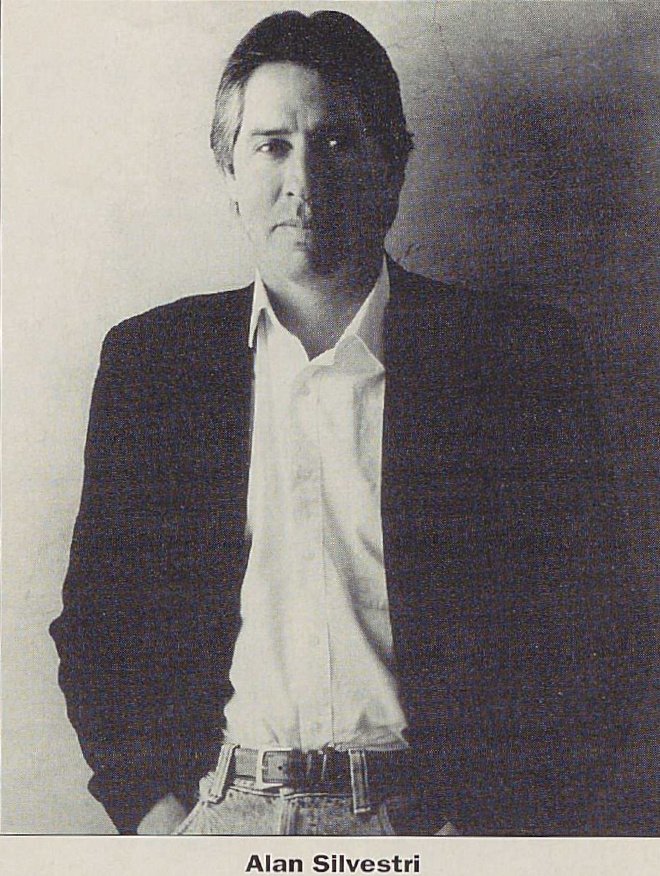
On CD sales correlating with box-office success. Comments from Hans Zimmer ("The Lion King"), Alan Silvestri ("Forrest Gump"), and Carole Bayer Sager (singer on "The Spy Who Loved Me").
Soundtracks, while always important for film marketing, have become an absolutely vital part of the entire entertainment industry. For the second year in a row, the top-selling album was a soundtrack, with “The Lion King” (at nearly $60 million) roaring on the heels of the well-muscled “The Bodyguard.”
These megahit records are good news for the recording, publishing, radio and music-video industries, but the rest of the entertainment community – including film, home video and cable – are benefiting like never before.
“The Lion King” reigned supreme on both the Billboard and boxoffice charts for months. Elton John and Tim Rice”s soaring crescendos did as much to sell the picture as Disney’s massive marketing machine. After all, the heralded trailer was the film’s opening sequence and featured the song ‘Circle of Life’ without further embellishment – in other words, it was a music video. Further tribute to the music’s power was a network primetime special that focused not on the making of the film but on the making of its music. And, of course, hundreds of radio stations bolstered the marketing might of the music, and MTV and VH-1 played the videos relentlessly, ensuring that teens, and adults without children, would go to see the film.
Which is not to say there weren’t other factors in rolling the film past the $300-million mark. However, Disney - long a master at using music to make magic in its films and at the boxoffice – had for the first time a hit single on the charts when the movie opened. The result was its biggest animated film premiere ever with grosses of $41 million. Many kids who left the theater dragged their parents across the mall to the record store.
If it’s tempting to dismiss the film as a phenomenon, consider the second -biggest-grossing film of 1994, “Forrest Gump.” It’s no coincidence that it also spawned the second-bestselling soundtrack, which went triple platinum in spite of its being a costly double-CD set that was essentially an oldies collection.
Still not convinced? Then consider “The Crow,” which was No. 1 on both the boxoffice and the Billboard charts. There was also “Reality Bites” and “Sleepless in Seattle.” The “Pulp Fiction” soundtrack is already platinum. “Fiction,” along with the “Murder Was the Case” soundtrack from Snoop Doggy Dogg and “Natural Born Killers,” used rock songs to heighten the eccentric atmosphere and expand the director’s vision rather than to merely find a hit single. Nine Inch Nails leader Trent Reznor, who produced the soundtrack for Oliver Stone”s “Killers,” placed his original single, “Burn,” alongside obscure tracks from Leonard Cohen (“Waiting for the Miracle”) and Patti Smith (‘Rock n’ Roll Nigger’).
Certainly there have been soundtrack bombs, for not all music is golden. That occurs because most often a soundtrack is a marketing afterthought to the movie. Yet even well-planned soundtracks may fail to take off. Robert Altman”s “Ready to Wear,” for example, isn’t breaking any boxoffice records. Its soundtrack album isn’t burning up the charts, in spite of a hit single and cuts from such superstars as the Rolling Stones, Janet Jackson and U2.
One of the latest trends in soundtracks is to get cable and home video into the act by re-releasing soundtracks or by issuing sequel albums timed to cable or video bows. For instance, the music stables of “The Crow” and “The Lion King” are expected to have sequel albums, just as “Dirty Dancing” did when it sold an extra 3 million albums.
The follow-up to “The Lion King,” titled “Rhythm of the Prideland,” will be released in March to coincide with the video release, says composer Hans Zimmer, who scored the film. He warns that the danger in follow-up albums is that they might be perceived as phony or exploitative. “Some of these follow-ups are incredibly phony,” he says. “If the marketing department is involved, it usually is phony. You have to have integrity.”
For “Rhythm of the Prideland,” Zimmer says that those involved worked hard to keep that integrity. “We spent more time on it than the original. We went back to Africa to work with the same choirs. The sequel must stand on its own.”
Zimmer notes that it takes so long to make a proper animated soundtrack that he is considering projects scheduled for the turn of the century. “I’m looking at things for 1999 and year 2000,” he says. “You get involved right from the beginning now. The composer is very much part of the team.” Meanwhile, Zimmer will busy himself with Tony Scott’s “Crimson Tide,” Chris Columbus’s “Nine Months”, and a Muppet movie.
Another film-music trend is to release score albums separately from the soundtrack albums (with the songs from the film). Alan Silvestri, who scored “Forrest Gump,” says: “That’s happening more and more. There is a consistently growing market for the score side of motion-picture music. The record industry has now found out that soundtrack and score albums are not mutually exclusive. So they put out two albums and let the consumer make a choice.
“The film industry has settled down on what scores bring to a film. For years there was confusion,” Silvestri adds. “Filmmakers would try to score their pictures with records. Now they realize both songs and the score are needed. They are using the songs and the score much more sensibly. ‘Forrest Gump’ is a good example. We used the music as time markers and used the score in emotional relationships.”
Silvestri recently worked on the upcoming Western “The Quick and the Dead” with Gene Hackman and Sharon Stone, the Cuban-music themed “The Perez Family” with Marisa Tomei and Anjelica Huston, and a “Tales From the Crypt” episode based on the movie “Casablanca” for director Bob Zemeckis.
In the world of soundtracks, the song remains the same, says songwriter Carole Bayer Sager. “As long as I’ve been writing (her first film song, ‘Nobody Does It Better,’ was with Marvin Hamlisch for “The Spy Who Loved Me”), there are a few things that are the same,” Sager says. “The songs may change and become grungier. The tone may change. The hot songwriters may change. But a great song or a great score will still underscore the drama of a film. ‘The Fugitive’ had a brilliant score, but it never said, ‘Hey, look at me.’ It didn’t call attention to itself. The main purpose is to serve the movie, to underscore its points (as) Nora Ephron did with ‘Sleepless in Seattle’ or (as) Tarantino’s choice of songs (did) for ‘Pulp Fiction.’”
Zimmer agrees: “Stuff goes through periods. It’s edgier now than before. But everyone is still trying to do the same sort of thing, tapping around in the dark for a hit to help the marketing. But unless you have a good music supervisor, it becomes a sad compromise.”
Hopefully, that won’t be the fate of some of 1995”s most anticipated soundtracks, including the Whoopi Goldberg starrer “Boys on the Side,” which has attracted the top females in rock music. The soundtrack was scheduled for release Jan. 24 featuring 11 new and previously released tracks from Annie Lennox, Sheryl Crow, Chrissie Hynde, the Cranberries, Bonnie Raitt, Indigo Girls and Melissa Etheridge. Arista Records chairman Clive Davis says the impressive lineup came about because of the content of the film. “They all wanted to be part of the film and the soundtrack, which is about female bonding,” he says.
Recently released soundtracks include John Singleton’s “Higher Learning” and “Tales From the Crypt Presents Demon Knight.” “Higher Learning,” on 550 Music/Epic Soundtrax, contains new songs from Ice Cube, Liz Phair and Mister Grimm as well as Tori Amos” cover of REM”s “Losing My Religion.” The “Tales From the Crypt” soundtrack on Atlantic includes tracks from Pantera, Ministry, Megadeth and Rollins Band.
Upcoming hot soundtracks will be New Line’s “Don Juan de Marco and the Centerfold,” which stars Johnny Depp, Marlon Brando and Faye Dunaway. It will include the Gypsy Kings, Chris Cornell from Soundgarden and a duet from Michael Stipe and Tori Amos. Warner Bros.’ “Batman Forever” will feature Robert Plant and Jimmy Page on the Atlantic Records soundtrack.
A soundtrack for New Line”s “Basketball Diaries” will be out in March from Island, featuring Soundgarden, the Posies and the Cult, with a score by Graeme Revell (“The Crow”).
Also promising is United Artists” futuristic “Tank Girl,” set for a March 24th release. The screen version of the cult comic-book favorite stars Lori Petty as the heroine, rap star Ice-T as part of a band of half-man, half -kangaroo mutants, and a cameo by punk rock legend Iggy Pop as Rat Face.
The “Tank Girl” soundtrack set for Atlantic also has a lot of credibility with alternative acts, particularly female alternative acts. Courtney Love is getting involved; Bjork will issue the first single, “Army of Me”; and Stomp and Luscious Jackson will write original songs. Interest has been expressed by Sinead O’Connor, L7, Babes in Toyland, Veruca Salt, and others. “These artists are coming out of the woodwork,” says MGM music head Marsha Gleeman. “It’s a hit underground comic with a female hero, so all these female artists and bands are interested. To make Tank Girl into a hero is a little scary, but I think Newt Gingrich is pretty scary, too.”
MGM has 24 pictures coming in the next year, all with music and almost all with soundtracks, Gleeman says. Like others savvy enough to recognize the potential of a well-planned soundtrack, Gleeman adds, “We are meeting with producers and directors in the earliest stages to make music a part of the film rather than an afterthought.”