Fred Karlin leads a workshop for young composers, and some well-known names have passed through its doors.
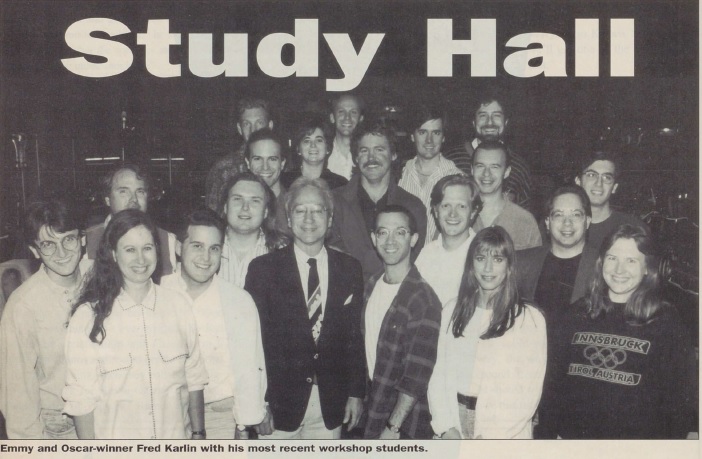
Where are tomorrow's film and television composers learning their craft? For many, the answer is at the annual film-scoring workshops put on by the American Society of Composers, Authors and Publishers (ASCAP) and Broadcast Music Inc. (BMI) conducted by, respectively, Emmy winners Fred Karlin (“The Autobiography of Miss Jane Pittman”) and Earle Hagen (“I Spy”).
Although they differ somewhat in format and reflect the individual styles of the composers, both are designed to teach trained musicians the basics of the field; as Hagen puts it, “the mechanics, and the psychology,” of film scoring. Every aspect of the craft, from concepts and timings to conducting and business issues, is examined over several sessions. Talks by working professionals (often including eminent composers) are also a key element.
In both workshops, participants write a two-minute cue for an existing film and conduct it with an ensemble of top studio musicians, then have it analyzed for musical and dramatic content.
The BMI workshop grew out of Hagen's informal sessions that he conducted at his own house throughout the 1970s (for which the entrance fee, Hagen recalls, was “three dozen golf balls” for eight weeks of instruction). Composers Bruce Broughton, Herbie Hancock, J.J. Johnson and Artie Kane were among his early students.
Hagen wrote “Scoring for Films,” the first important text in the field, in 1971, when discussions about a BMI workshop first began. BMI began the formal series (twice a year, with students taking classes twice a week for eight weeks) after Hagen's retirement from weekly TV scoring in 1986. More recently, the work shop was scaled back to once a year.
BMI receives as many as 120 submissions (demo tape plus resume) for the 20 available spots in each class. Hagen conducted his last workshop in 1994. BMI is now in the process of designing a new course expected to begin next year.
Karlin, who is also an Oscar winner (for the song ‘For All We Know’ from “Lovers and Other Strangers”) began teaching the ASCAP workshop in 1988; his eighth class is scheduled for January. Like Hagen, he donates his time, while the ASCAP Foundation provides funds for the orchestra session, the largest single expense.
Interestingly, Karlin does not choose the 14 participants. They are selected by ASCAP officials based on the recommendations of a panel of composers who review audition tapes and resumes of the estimated 150 applicants annually. Karlin never hears their music until the scoring session late in the series.
“The other requirement,” Karlin explains, “is that they not already have scored major motion pictures and television projects, (although) almost all are working professionals,” often as jingle writers, orchestrators for other composers or scoring music for such low-budget efforts as straight-to-video films or interactive projects.
Like the BMI class, the course is free to those who are invited to participate. The ASCAP work shop naturally utilizes Karlin's own film-scoring text, the 1990 “On the Track,” which participants must obtain.
Why does Karlin continue to conduct the workshop? “There's more and more interest on the part of young people who are coming into the profession, who actively want to be professional film composers,” he says. “They should have the benefit of as much of our experience as possible so that they can be as good as possible, as quickly as possible.”
Among the composers who have gone on to scoring success after the BMI workshop are Bruce Miller (NBC's “Frasier”) and Dennis Brown (ABC's “Grace Under Fire”). Past ASCAP workshop participants have included Cliff Martinez (“sex, lies and videotape”) and Lynn Kowal (who wrote the theme for NBC's “Homicide: Life on the Street”).