Music supervisors see big bucks in tying singles to movies.
Never was a title more appropriate to the concerns and hopes of the marketing executives of a movie studio and a record label than Whitney Houston’s upcoming picture, “Waiting to Exhale”.
That collective sigh you heard last month was from Fox Filmed Entertainment and Arista Records bosses who finally let out their held breath at the news that the pop diva had agreed to record two of Kenny “Babyface” Edmonds’s songs on the film’s all-female soundtrack.
Arista will release one of Houston’s tracks as the first single from the album in September, with the album (which also features Toni Braxton, Aretha Franklin, TLC, Mary J. Blige and others) due Oct. 10 and the movie set for November.
To understand why everyone is so delighted, think back three years to the release of Houston’s last picture, “The Bodyguard,” which co-starred Kevin Costner. Not only did the singer’s hit, “I Will Always Love You” smash sales records by selling more than a million copies in the week before Christmas, it also propelled an average picture to $150-million-plus boxoffice grosses. The Arista soundtrack album went on to become the biggest seller ever at 15 million copies.
It was the perfect example of how crucial hit songs and sound track albums have become to the marketing of movies and vice versa. Such varied films as “Friday”, “The Lion King”, “Pocahontas”, “Batman Forever”, “Forrest Gump”, “Bad Boys”, “Pulp Fiction”, “Don Juan DeMarco”, and “Boys on the Side” have reaped similar benefits.
The concern with “Waiting to Exhale” was that, unlike “The Bodyguard,” Houston does not play a performer onscreen. Only when she heard the Babyface songs did she decide to record.
“This is a very different property,” says Robert Kraft, exec vp, music, Fox Filmed Entertainment. “We first had to attend to Whitney’s role in the film. As to the music, it was truly the involvement of Kenny Edmonds that made it all happen.”
Kraft acknowledges that the role of studio music chiefs has changed over the last ten years. “Marketing may be becoming the most important part of what we do,” Kraft says. “It’s not about having eight trombones under the car chase anymore. What I hope to do is service the film, the director and the property as well as think of the music as a tool to market the picture. Videos and radio are great free advertising for your picture, so you look for that smash single that will sell the movie.”
Gary LeMel, now Warner Bros.’ music chief, was at Columbia Pictures in 1984, which saw the first huge demonstrations of how music and movies can dovetail in marketing. That was the year of “Against All Odds” and the Phil Collins hit, ‘Take a Look At Me Now’, “Ghostbusters”, with Ray Parker Jr.’s title smash, and “The Karate Kid,” with Peter Cetera’ s chart- buster.
LeMel was one of the first executives to be brought in from the record business. Now, studio music executives and label film specialists work hand-in-hand.
For Warner Bros.’ “Batman Forever,” Atlantic Records got involved with the soundtrack and early singles from Seal (‘Kiss From a Rose’) and U2 (‘Hold Me, Thrill Me, Kiss Me, Kill Me’). With videos playing on MTV, VH1, BET, campus and regional video operations and The Box (the cable video-jukebox), two weeks before the opening of the movie, LeMel had what he calls a “textbook case. Most of the target audience for the movie knew about it.”
LeMel says he had heard the Seal cut on Seal’s own album and thought it would be perfect for the film. “I also knew it was a smash record,” he says. “In my mind, it’s all about marketing. I have to remind our people that we’re in the marketing business.”
A key element was that LeMel was able to obtain the single rights to the song. “So whether it was on Seal’s own album or not didn’t matter; we had the single rights,” he explains. “We had U2 set for our soundtrack album but at first we didn’t have the single rights. But when U2 heard it, they knew it would be a smash too, so they wanted a single too.”
Proof of the pudding was that not only did “Batman Forever” open to huge grosses but well into August the film’s soundtrack album was in the Billboard album Top 10, and both singles were in the singles Top 20. Joining them at the top of the singles chart were songs from other current movies: Vanessa Williams’ “Colors of the Wind” from “Pocahontas,” Diana King’s “Shy Guy” from “Bad Boys” and Bryan Adams’ “Have You Ever Loved a Woman?” from “Don Juan DeMarco.”
Getting the right artists with the right songs and videos set for release at exactly the right time has become a new Hollywood science. “We work hand-in-hand with the record label,” says Chris Montan, senior vp, music at Walt Disney Pictures.
John Secada’s ‘If I Never Knew You’ is the next “Pocahontas” single for September.
Timing is everything. “It’s not easy, it’s a very difficult thing to do,” says Harland Goodman, music chief at Paramount. “Studios don’t want to decide on final numbers until they see the movie. By that time, you’re often six weeks away from an answer print. The record label wants art work 90 days in front. It’s a big problem.”
Harry Garfield, senior vp, music at Universal Pictures, also stresses that the music must serve the film first. “A hit song is very beneficial when it’s at the heart of the movie rather than just being tacked on,” Garfield says.
Still, music, especially videos, are worth the trouble even if they don’t help a movie open. “I believe music can give a movie legs,” says Burt Berman, executive vp, music at Sony Pictures Entertainment.
Sometimes a hit song is timed just right. Mike Regan, director of marketing at A&M Records, is currently focused on the sound track for the Warner Bros, release, New Regency’s “Empire Records,” starring Liv Tyler. The first single from the album, ‘Till I Hear It From You’, by the Gin Blossoms, came out on Aug. 8, and with the help of an appearance by the group on the Letterman show, a hot video and headline dates around the country, it has become a smash hit. “It was an incredible success right out of the box,” Regan says.
Mitchell Leib, New Regency’s senior vp of music and the film’s music supervisor, was co-executive producer of the album with Jonathan McHugh, A&M Records’ director of film music. Leib describes “Empire Records” as “‘Breakfast Club’ in a record store.”
“It’s wall-to-wall music,” he says. “The flavor of the month is youth-oriented pictures with alter- native rock soundtracks. The problem is that many artists have been used up.”
Leib wanted a single to carry the marketing of the movie and he had been paying close attention to the Gin Blossoms, whose most recent recording was the double- platinum album, “New Miserable Experience,” in 1992. A&M Records, however, would not release the group for a single unless they were involved with the entire soundtrack album. “A&M is a boutique label with a string of bright young artists,” Leib says. “It had taken them a year to break the Gin Blossoms, and I knew that if we went with them on the album they would be on the line to deliver. My job is to serve the film and look at the marketing. The label wants the movie to do well, but their agenda is the record.”
A&M’s McHugh agrees, but says labels want movies to do well too because it helps the artist. “I’ll try to find different ways to market your artist,” McHugh says. “I try to place songs in films and TV shows so that people will get a different impression of my artists.”
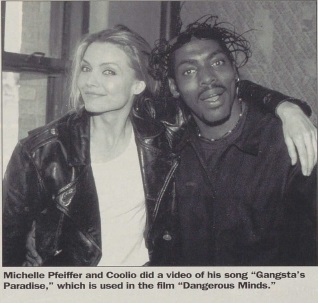
Competing for attention this month has been “Gangsta’s Paradise,” by Coolio from the Michelle Pfeiffer-starrer “Dangerous Minds.” Kathy Nelson, soundtrack supervisor at MCA Records, worked closely with producers Don Simpson and Jerry Bruckheimer on the music for the film and the accompanying video. It features Coolio with Pfeiffer in specially-created scenes that reflect the feel of the picture.
Nelson regards videos as the essential marketing tool. “Video channels are totally geared to peo ple who are into music,” Nelson says. “The repeat viewing is more important than an artist’s appearance on a network show. On a show, too, you don’t have the connection with the movie that you do with a cool video.”
MCA also has Peter Gabriel’s ‘Party Man’ pushing “Virtuosity,” starring Denzel Washing ton and soon Salt’n’Pepa from ‘Too Wong Foo, Thanks for Everything, Julie Newmar’ and Chaka Khan from Spike Lee’s “Clockers.”
Key to music marketing, of course, are MTV and VH1, where movies, songs and videos come together. “We, all three, benefit,” says Andy Schoun, senior vp, music and programming at MTV. “A great song, with a great video and footage from a great movie makes for great television.”
Lee Chesnut, vp, music programming at VH-1, agrees. “When we program music, we’re not necessarily trying to sell the movie. We’re selling the song,” he says. “It’s a hit-and-miss situation. But when it all comes together, we only stand to gain.”
Maureen Crowe, currently soundtracks vp at Columbia Records, was responsible for bringing ‘I Will Always Love You’ to “The Bodyguard” party. She assembled the soundtrack to “Ready-to-Wear” which, despite the film’s poor showing, was a hit album led by Ini Komoze’s reg gae-flavored “Here Comes the Hot Stepper,” and tracks by the Cranberries, Janet Jackson, Salt’n’Pepa and the Rolling Stones.
“From the marketing research,” Crowe says, “sound tracks sell when they have a hit single and a compilation of familiar artists. If they like the film as well, that’s even better.”
Studio music supervisors must, however, embrace a wide range of musical styles. For the upcoming Tri-Star thriller “Devil in a Blue Dress,” based on the Walter Mosely mysteries and starring Denzel Washington as a ‘40s Los Angeles detective, Crowe assembled a compilation of blues tunes from the period led by T-Bone Walker’s ‘Westside Baby’. Then it was an about-turn for a collection of ‘70s bubble-gum songs such as ‘Sugar, Sugar’ and ‘Knock Three Times’ for New Line’s ‘Now and Then’, starring Demi Moore and Melanie Griffith.
“We want everything – the film, the music, the videos, the advertising to reflect each other,” Crowe says. “You’re selling the concept of a compilation, but if you don’t have a complete film tie-in, it’s an uphill climb.”
Which is why the folks behind “Waiting to Exhale” are sitting pretty, and so is another of Crowe’s competitors who is reaping the benefit of Whitney Houston’s extraordinary success.
Matt Walker, vp of live action music at Disney/Touchstone, has Houston’s “The Bishop’s Wife” to look forward to next year. Denzel Washington co-stars in the remake of the Cary Grant/Loretta Young film in which Houston plays a choir mistress at an urban church.
“Coming from gospel music as she does, Whitney will be bringing classic gospel numbers and hymns to the soundtrack,” Walker says happily, “and at least one or two new hits in time for the holidays next year.”

Vocal arranger David Friedman works with singer Judy Kuhn on the soundtrack of Disney's "Pocahontas".