Wiseman briefly comments on current projects, including recording Zulu singers for "The Dying of the Light".
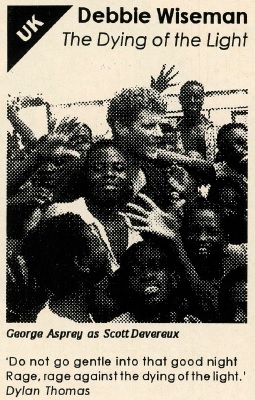
On the evening of the 2nd of January 1993, in the lawless port of Kismayo in war-torn Somalia, UNICEF worker Sean Devereux set out to walk the 400 metres from his office to the house where he lived. He never made it. An assassin stepped from the shadows and shot him twice in the back of the head. Fellow UNICEF worker Caroline Tanner radioed for medical assistance, but by the time it arrived, forty minutes later, 28 year old Sean was dead.
In November ITV presented its first ever themed season “The War Machine” and as a centrepiece in a week of programmes focusing on the arms trade, Yorkshire Television retold Sean Devereux's story in a prime-time two hour drama entitled “The Dying of the Light” directed by award-winning Peter Kosminsky, and scripted by Hossein Amini.
For the musical score, Kosminsky wisely chose Debbie Wiseman to provide the music. In only a few years, Ms. Wiseman has been building up an extensive list of notable credits for television and now for the cinema.
I recently asked Debbie about her involvement in this remarkable documentary. “I met with Peter Kominsky who had heard some previous stuff I had done. He knew he wanted to use voices in some way, but wasn’t quite sure how it was going to work. We talked about the way we could make It sound African, but still dramatic because some African music is nice on its own but wouldn't necessarily work with the film because it was a very tragic story. It had to be haunting and memorable and he also wanted it to be melodic. A really lovely man to work with. We had a mixture of singers that could read music and traditional Zulu singers. They picked it up very well and it was good fun.”
Debbie's first film and score, and indeed her first CD to date is for “Tom and Viv” starring Willem Dafoe and Miranda Richardson opened in the States during late November. “It did okay here,” Debbie told me, “It certainly wasn't a mega-blockbuster, but didn’t do badly. We did more music for the American version because we used music in the British version very sparingly, but when they viewed it in America, they wanted more music, which was great so we put in another 12 cues.” [The soundtrack is available on Sony SK 64381 UK].
Debbie shows no sign of slowing down and has quite a number of projects to hit British TV screens during the beginning of 1995. “Incredible Evidence” is a 90 minute film in the Equinox series tracing people that have been wrongly convicted due to fingerprinting, DNA etc. “There is an awful lot of music in it and it goes out towards the end of December on Channel Four.”
“What Did You Do in the War, Auntie?” Is a two-part BBC series being transmitted in April and it will also have a video release. “It follows peoples’ stories of what happened during the war and also a chronology of what the BBC was doing at that time. The music is period, dramatic if needed, but I think the title tells all really! Very good fun to do.”
Lastly, coming up during Sundays from 26 March is “Satellite Wars” for Channel Four. It tells the story right from the early days of Satellite Broadcasting In this country and how official-backed broadcasters lost out to Rupert Murdoch's SKY network. Positive proof that Debbie Wiseman is one of Britain's most innovative composers working in the media today.