Serra talks about how he approached the violence in the film, seeking to give it heightened emotion. He feels the classic James Bond theme is "old-fashioned" and created a more processed score for the character.
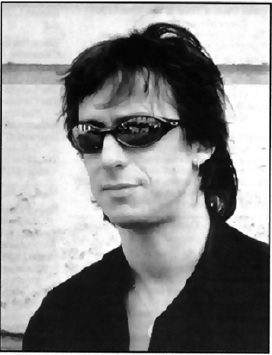
Eric Serra should consider himself the luckiest composer on the face of the earth (next to Monty Norman). When regular, legendary James Bond composer John Barry proved either unwilling or unable to score this year’s “GoldenEye”, starring Pierce Brosnan, Eon Productions sought out a new sound for their cash cow. Not wanting to go the route of the traditional Hollywood scorer, as they had done with Michael Kamen on the last Bond movie, 1989’s “License to Kill”, they settled on the relatively un-tried Serra. Unbelievably, the 36 year-old musician had to be talking into accepting the job! He is better known as a rock star in his native France, and has only scored films mainly for his friend, director Luc Besson, a productive relationship which has resulted in “Subway” (1985), “The Big Blue” (1988), “La Femme Nikita” (1990), and “The Professional”(1994). I caught up with Serra shortly before “GoldenEye’s” opening, when he was doing interviews for Virgin’s soundtrack album. To his credit, his is a soft-spoken, pleasant man, and we managed to break through the language barriers not only of French-English (not a problem, his English is excellent) but more significantly music-words.
Could you discuss how you decided to approach James Bond?
How I decided to approach the music?
Yes.
Well, as usual [laughs], I didn’t have a special approach because it was a James Bond movie. I just tried to do what I feel, as I do usually. When they called me to score this movie, they said that they were big fans of my music, so I thought the best thing was to write my music, and not to be influenced by the old James Bond.
Had they temp-tracked it with “La Femma Nikita” and “The Professional” and things like that?
Yes, I think they had temp-tracked some things with “La Femma Nikita” and “The Professional”, but just a little bit. And actually the copy they gave me was without any temp track. So I just did what I wanted.
Well that makes a short interview [laughs]. Are you a big James Bond fan, did you look back at the older films at all?
I didn’t look back because I’m a very big fan, so I knew everything. I could describe all the movies. I had old James Bond videos, not since I was born, but almost, and I’ve seen all of them probably ten times each. So I knew it perfectly.
Was that intimidating?
Well, yes, of course, because to me, it’s such a huge legend that to enter this legend was very impressive and scary. It was my first American movie, too, but as I signed it, I had to do it, so I had no more time to be scared.
How much did you have to do it?
Six or seven weeks.
How much music is there in the picture?
There is an hour and ten minutes of music which is 47 cues.
You had only done films before for Luc Besson. Was it challenging or frightening to have to work for a different filmmaker?
In the beginning, yes, because I didn’t know how it would work. With Luc Besson, he always has a precise idea of what he wants, not in terms of music because he’s not a musician, but in terms of the emotion. He usually knows precisely what he wants to create with the music on each sequence. He comes to my studio almost every day, I play what I have composed, and we discuss it, so usually it’s very close work together. This time, with Martin Campbell, he didn’t really know precisely what he wanted, so he left me much more free to do what I wanted, which at the beginning was very scary and finally very enjoyable because I had a lot of fun – I could do what I wanted and just have fun. So it was very interesting to have this experience, so that now I realized, I think now after this movie, I could score any more. I wouldn’t be scared now.
You used your “industrial” sounding music a lot that was featured so well in “La Femma Nikita”… was that just your choice, or…?
What do you mean?
I guess I’m just going back to the fact that there’s such a pre-conceived notion of what James Bond sounds like. I think in film scoring a lot of times, people look at the music and will discuss how it was written based on the choices that were made as far as this scene or that scene. But it seems a much bigger choice is just the fact that you would do your sort of style from “La Femme Nikita” or “The Professional”, with the very percussive, industrial… I don’t know [laughs], I’m making no sense.
No, I understand what you mean. When they hired me they told me that they loved my music, and they really let me free to do what I wanted, so I did what I was feeling. So sometimes I feel on a special sequence, I will hear “industrial” music, as you say, usually I don’t call it like this, but I didn’t know what you mean –
I couldn’t think of a - well, what do you call it, just ‘you’?
I don’t know, I don’t call it, I compose it. And sometimes on another sequence I will feel something completely orchestral and very classical, and sometimes I will feel something a mix between orchestral and percussion. Usually I don’t decide I’m going to do this, or I’m going to do this, I really score as I feel. It’s usually after six or seven cues that I start to have an idea of the global thing.
Well, how did you start scoring “GoldenEye”, what were the six or seven cues you started to work on before you got that idea?
I started in a chronological way. I started with the very beginning of the movie – the opening is all action, so the music is very, if I have to compare, it’s a little bit like “The Professional” with a lot of percussion and low sounds which gives the suspense. After that there is a sort of car race, car chase on which I did a very funky, fast rhythm thing, but much lighter than the beginning because there was no suspense. And then after that there was a sort of romantic sequence, completely orchestral. So after all these cues I thought I had all the different styles that would be there until the end. There was the suspense, the tragic part, the romantic part, and the fun part. So it was six or seven cues.
Did you have any involvement with the title song?
The first one, no, the one sung by Tina Turner, it has been written by Bono. But I have composed the end title song.
Did you do the trailers?
No. Actually I have not seen it so I don’t know if they put in some of my music or not. [They didn’t; I later found out it was an original piece by trailer composers Starr Parodi and Jeff Fair; no album release is planned. – LK]
How do you actually create your music such as the more percussive-styled… I know it’s synthesized, but how do you law down tracks, or think of the sounds or whatever?
Well, it depends, some of them I program, some of them I play. I use a lot of percussion all the time because I go very often to Africa and then when I come back I loop it, in samplers. There is no rule, sometimes it is completely synthetic and completely programmed, sometimes it is played, sometimes it is looped; there is no rule.
How do you process those vocals? It’s a very deep, processed sound…
Well I used a couple of different samplings, some come from… it all comes from Russian traditional sounds, Russian folklore voices that I have sampled and completely transformed and it’s almost impossible to recognize. I usually do this all the time, I love to mix a lot of different things coming from totally different continents. That is why I like for example to mix African percussion with symphony orchestra with synthesizers with vocals from some ethnic records. I like to mix everything.
[pause] Do you find that you don’t really like talking about your music?
[laughs] It’s not that I don’t like, it’s that it’s very difficult to talk about music. I think when you are a composer it means you have some problems expressing yourself with words. So what I can express with the music is very difficult for me to express with words. That’s why to talk about the music is a sort of translation of the music, which I can’t really do. Also, I’ve been doing music since I was five years old so music to me is totally natural, I’ve never learned. It’s completely natural and it’s something I can’t really explain. I don’t know how it comes and I don’t know – I can’t explain.
I understand. It’s hard to talk about music, but I find it easier to talk about film. I mean James Bond is such a… O.K., here’s an actual question: How did you treat the violence, the action in a James Bond movie as opposed to the violence in a Luc Besson movie?
The difference is that on “The Professional”, for example, on all the action scenes, Luc Besson wanted me to bring the emotion. He didn’t want the music to double the violence. He wanted the action scenes to be still very emotional, so that when you had an action scene, you could feel the emotion of Leon or the little girl, Matilda, and that was brought by the music. It gave all of the movie a very deep and tense feeling, and very emotional. In the James Bond movie the action scenes are much lighter, I would say. It’s not tragic. It’s more, it’s action, but not sad action. So the music is much more connected to the action than to the emotion. [chuckles] Does this answer your question?
Yes, thank you! [laughs] I’m sorry if this is awkward… what are your favorite James Bond movies from the past?
My favorite one? Probably “Goldfinger”. I love all the ones with Sean Connery. They are all my favorites. But if I have to choose one it’s probably “Goldfinger”.
How did you work with the John Barry Bond theme? Did they request that you use that in some scenes, or did you decide to use it…?
Yes, they requested me to use it a couple of times in the movie, so I used it. It’s actually not John Barry’s, it’s Monty Norman.
Well, that’s what the credit reads, but as far as I know, on the very first James Bond movie, “Dr. No”, Monty Norman did the music, and it just wasn’t working for them, so they hired John Barry to do the James Bond version of the theme that we know as the James Bond theme, and then on subsequent films they hired Barry.
Yes, but I think the theme has been composed by Monty Norman, I am 99% sure. I think this theme is a nice one, but it is a bit old-fashioned now. So the most difficult thing was to use it and to make it sound modern, which was not so obvious because I think every time they have used it, it always sounds old-fashioned. I think I found a way, so… [chuckles]
I heard that towards the end of the movie [more like the middle, I later found out] there is a more traditional arrangement of the Bond theme. Was that done by you, or…?
No, that was done by my conductor, because I didn’t agree with this. I had composed a very modern version, and I think they were a bit afraid because it was too modern [laughs], so they finally asked my conductor to do an orchestral version of the James Bond theme. I didn’t quire agree because it’s a pity to… we did the whole score in a very modern way and a very new way, so I think it’s not an especially good idea not to do it 100%, just on one sequence to do an old version. So I didn’t do this one.