The son of Arthur Rubinstein talks about his life in music and acting. He has bounced through piano performances, stage acting, film composing, and met a number of prominent men along the way. He recounts how he got his first film, "Jeremiah Johnson" and how he handled a situation where his music in a TV movie was misused. He describes how he wears many hats along with that of being a father.
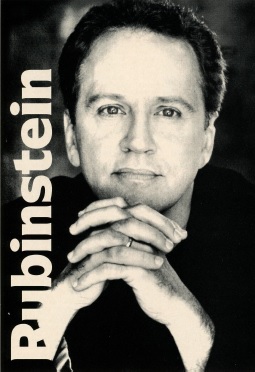
Though perhaps best known for his role in the hugely popular television series “Crazy Like A Fox”, John Rubinstein has a long and varied list of credits. John's acting career has included Broadway and regional theatre, feature films, mini-series, and television films. He has appeared as a guest in series such as “Barnaby Jones”, “Fantasy Island”, “Frasier”, “Hawaii Five-O”, and “Worlds Apart”. He has directed many theatre productions and some television If that were not enough, John has also composed music scores for features, television, theatre, and radio. John has been a featured musician on several albums and narrated for a number of talking-book recordings. I spoke to John late in 1994, when I began by asking him about his background and how he came to be active in so many different professions.
I was born in Los Angeles on December 8, 1946. My parents had moved here during the war with my sister Eva and my brother Paul, who had been born in Buenos Aires, Argentina, and Warsaw, Poland respectively. They gave up their house in Paris, and, via New York, came to Hollywood. My sister Alina was born here almost two years before me, and I was the youngest.
In terms of music, my father was Arthur Rubinstein, the concert pianist. My mother’s father, Emil Mlynarski, was a famous conductor and composer in Warsaw. My father and he, in fact, played concerts together before my mother was born. All four of us children took piano lessons, but Eva and Paul abandoned them rather early . I started when I was four, with a teacher here in Beverly Hills named Janet Gold. Alina was six, and we kept up our lessons throughout High School. We moved to New York in 1954, and continued our schooling there, taking two piano lessons a week all through that time. In the summers we would travel with our father through Europe as he gave his concerts (my parents had re-acquired their Paris house). In Paris we had another teacher who would teach us during the summer months.
We were both talented, musically speaking, not necessarily pianistically. I was more the ‘performer’; Alinawas more serious about getting it right. We were forced by our parents to play for their friends and dinner guests starting at a very young age. I have, I say with a pride of accomplishment, but with some objective awe and residual trauma, played the piano for Emil Gilels, Nadia Boulanger, Margeurite Long, Igor Stravinsky, George Szell, Francis Poulenc, Darius Milhaud, Henryk Szetyng, Nathan Milstein, and a whole host of other people for whom nobody in his right mind would ever choose to play! It actually got to be too stressful as my sister and I moved into adolescence and realized what was going on. I rather enjoyed the attention and the spotlight, but I was musically knowledgeable enough to know that I had a weak technique; I began to dread the evenings when there were going to be guests. Alina and I played four hands when Edward R. Murrow brought his cameras to our New York apartment for his “Person to Person” live TV program in 1956. I butchered my part of the piece from the “Dolly” suite by Gabriel Faure; I still have the film of it. Traumatic. In short, I knew that I would never be a real pianist.
When I was sixteen, I decided to give up my piano lessons. My parents were disappointed, but they could do nothing about my decision. By that time I had fallen in love with the theatre. I went to the theatre in New York all the time, and acted in school plays and even amateur community theatre in the city. I knew by heart all the scores of the Broadway musicals that I saw (pretty nearly all that came through from 1954 through the mid-sixties); had discovered Fred Astaire movies, was crazy about his singing (and dancing) and loved the music that was in all those ’30s and ’40s films. The songs from shows and films were also possible to play on the piano without practising for hours and hours. Very soon I could play by ear all the Gershwin, Porter, Kern, and Rodgers songs; I sang them, too, and it became clear to me that I wanted to perform, and to write Broadway musicals! I also had always been a movie fanatic; so had my father, and I would go and see a film ten or twenty times if it appealed to me. “Tom Jones”, “West Side Story”, “Exodus”, “The Great Escape”, “To Kill A Mockingbird” were some of the films I saw repeatedly. All had amazing music, I might add!. I thought I was just having a good time, which I was but I was also learning to act, and by osmosis, learning how to score films.
Since music was such a basic component of my life and my awareness, the movie music and the show music I heard were profound influences on me; I noticed and paid great attention to them. I found I could also absorb a whole different world of music without leaving behind my roots in the classical music my father played. He tended to think of me as a “traitor” in those days, however. I had all the records of the original casts and the movie soundtracks, and I played them over and over.
In 1964 I moved to Los Angeles to attend UCLA, strictly for the purpose of attending the Theatre Arts Department, and because the school was in “Hollywood” where I could presumably start an acting career. I did a lot of acting in college, and directing; I started to act professionally in summer theatre (doing Camelot with Howard Keel, South Pacific with Patrice Munsel, etc.) and on TV, doing small parts on “Dragnet” and “The Virginian” and the like. At school, around the theatre, I was the guy who came from New York and played the piano by ear (I remain to this day a sight-reader on the level of a first year student!) and knew all the shows. So other directors, students and faculty, began to ask me to supply music: incidental music for plays, accompaniment for musical comedy scenes and shows, audition and rehearsal piano. I wrote a ballet, Beauty and the Beast, for two pianos. This was the first time I ever had seriously written out all the notes for something. A friend and I recorded the parts, and the music played in a children’s show in which I played a big white bunny rabbit. I wrote a revue in 1966, “A Much Too Intimate, Not Too Musical, Somewhat Satirical Sort of Revue” with other composers (one of whom is now a film composer, Charles Bernstein, a close, dear friend, and a brilliant drummer, bassist, and composer).
This show was a hit, so the next year the teacher who ran the Musical Comedy class gave me and my lyricist David Colloff a ‘commission’ to write a full-fledged musical. We did, and it was called “The Short And Turbulent Reign Of Roger Ginzburg”. I decided to expand the accompaniment from just piano, and jumped headlong into ‘orchestrating’ the score. I recruited students at UCLA's Music Department, and wrote parts for clarinet, flute, oboe, trumpet, trombone, bass, and drums. My friend Charles Bernstein played drums, and another friend, Roy Rogosin, conducted. We entered a national college competition with it, the BMI Varsity College Musical Award, and won First Prize.
I didn’t graduate from UCLA. I left in the middle of my last year because I got a job acting in a musical, On A Clear Day You Can See Forever in a bus-and-truck touring company around the U.S. and Canada for six months. A steady job. On the road, I became close friends with the members of the band who travelled with us, and after the performance every night we would find a piano in whatever hotel we were in, and the two trombonists, the clarinetist and flautist, the oboist (an ex-baritone saxophonist), and the first trumpet player and I would ‘jam’. This was pretty new territory to me. I had played and practised classical music all through my childhood; I had ‘switched’ to Broadway and movie music, and standards. But I had never improvised with other musicians in a ‘jazz’ mode. I learned an enormous amount during that time. About orchestration, harmony, theory, music history, and it did strike me as odd (I had never thought about it before in this way) that my father, arguably one of the greatest musicians of his day, never made me learn harmony or theory, composition or orchestration, when I was obviously drawn to music and relatively untalented at the piano! So, rather late in the game, I began to open my ears and improve my playing somewhat. This was in 1968, a big year for the U.S. and for me.
When I returned to L.A. to resume my TV acting, a woman I had known at UCLA, Tamara Asseyev, who was now starting to produce movies, and remembered my ‘music-writing’ from school, asked me to score a film she had just produced. It was called “Paddy”, a story about a young man in Dublin having trouble figuring out what to do, a ‘coming-of age’ story, directed by Daniel Haller. Tamara had shot it in Dublin with Milo O'Shea and many of the Abbey players. A modest movie, with an even more modest budget! Most of which was now used up, so she needed a score cheap!
I had only orchestrated one thing, really: the score to Ginzburg, my UCLA musical. The budget of “Paddy” allowed for few instruments, so I wrote a score for piano (again unwritten and played by me), brass, woodwinds and percussion (drummer: Charles Bernstein). It was edgy, Irish, jazzy, and lilting. The music ‘editor, John Caper. jn., introduced me to the unfamiliar territory of frames-per-second, and ‘spotting’. We recorded it without picture, and without click-track, so all the timings were approximate, based on my metronome from home, which I brought to the session. By some miracle (and with a few fuzzy moments) it worked. The title song ‘Paddy’ (lyrics by David Colloff, my UCLA partner) was sung by Judy Kaye, another UCLA friend, who now has a big career on Broadway (a Tony Award for Phantom of the Opera) and in the light opera, but the bosses at Allied Artists, who released the film, re-recorded the title track with Emmylou Harris singing the vocal. She later became a big star in country and pop records.
I had thought “Jeremiah Johnson” was the first film you scored and it remains your only score commercially released. How did you come to work with Pollack?
It was the second film I scored, but was my first big studio film. My acting agent represented an actress named Delle Bolton (by total coincidence, she was married to my lyricist friend David Colloff) whom [I had acted with at UCLA. She had been cast as the Flathead Indian wife of Robert Redford in that movie, so our agent was aware that Sidney Pollack was looking for a particular kind of score, and, knowing that I was a budding composer, he managed to arrange a meeting with me and Pollack. I played Sidney a tape of “Paddy”, and he said he was looking for five songs to introduce the five sections of what was then called “The Ballad of Jeremiah Johnson” . He was thinking, he said, of Kris Kristofferson, but wanted an unknown; he said he also may want some underscoring in a couple of places. He asked me to make him a tape of something.
One of my dearest friends at UCLA, and he remained so until his early death in 1986, was Tim McIntire. Son of actors John Mclntire and Jeannette Nolan, he was one of the most talented people I ever knew; a great-looking man with a huge, unique voice (he later made a fortune doing voice-over commercials), he was an exceptional actor. He starred in the films “American Hot Wax” and “Brubaker” and a host of others (one of James Stewart's sons in “Shenandoah”). He also was a natural and brilliant guitarist and violinist, and sang in a deep Western voice that was perfect for a movie like “Jeremiah Johnson”. He and I spent many hours of many years playing and improvising together, so I went to him and said “Let’s come up with something for this movie.” He read the script, and wrote a song (which remained the title song in the picture) which we recorded in my living-room, with him singing his lyrics and playing guitar. We also improvised some music with me on piano and him on violjn, and I wrote a little piece for violin, piano, and flute, which a neighbour flute-player helped out on.
We sent the tape to Sidney, who then had me and Tim come in, and he hired us to write the five “ballads” and whatever other little music he would need. We were terribly excited, and started working. About two weeks later, Sidney called me up with a bad tone in his voice, and said “The Warner Brothers studio brass have seen the picture, and they have decided they want it to be a big ‘roadshow’ and have a big, traditional orchestral score… Can you do that?” He expected me to say I couldn’t, but of course I said “Sure, no problem! “ He then asked me to write a 10-minute cue for the opening ten minutes of the movie to use for the trailer to be shown to the foreign distributors.
Now that I think back on it, I'm not sure that this request wasn’t a very diplomatic way of having me audition; but at the time, it felt like just a part of the job. My first time writing for a full orchestra! So I quickly bought Walter Piston’s books on orchestration and harmony, another book on orchestral notation, and jumped into a world that although I knew intimately by ear, instinct, and observation, was one in which I had virtually no education or training.
A few days later, I conducted a small orchestra of about 35 (my first conducting ever!). It went well. Actually, I was surprised at how good the sound was; very Coplandesque, naturally, but I am such a worshiper of Copland that it didn’t bother me at all. I was nervous about my lack of conducting technique, however, and months later when the full score was written (now for an orchestra of 85 on the big sound stage at Warner’s in three day-long sessions!)
I asked my friend Roy Rogosin (who had conducted Ginzburg and “Paddy”) to conduct. It was his first time in the movie big leagues, too, although he had been conducting for Johnny Mathis on the road for some time. Tim wrote three songs, music and lyrics; he sang them, played guitar, and did a narration for the movie as well. Together, we wrote another song. He and I solidified our improvised piano-fiddle duet, and used it for the cue where Jeremiah and his wife and son build their cabin. I incorporated all these themes into the background score, and the result pleased everyone.
Yes, “Jeremiah Johnson” remains the only one of my scores released commercially, except for my themes which are included on a “China Beach” commercial recording, and my one theme which is included on the album for a movie I starred in called “Zachariah”, with Don Johnson, scored by Jimmy Haskell, and directed by George Englund.
Some months after I finished “Jeremiah Johnson”, Robert Redford called me up and asked me to come in and meet Michael Ritchie, who had just directed “The Candidate” with Redford. I ended up scoring that film, too. This time I did my own conducting, and have done so on every project since then. In the orchestra were Shelley Manne on drums and Ray Brown on bass, two jazz stars, play my music.
Another unexpected thrill came a year later when Jeremy Larner won the Oscar for his screenplay of “The Candidate”; as he ran up on stage to accept the award, I suddenly heard my “Candidate” theme played to the world by the Academy Award orchestra. I'll never forget that!
Do you insist on conducting and orchestrating your own scores? A number of composers use orchestrators because there is never enough time.
“The Candidate” was, as I mentioned, my third score, and the first that I conducted myself. I have conducted every one since. I have orchestrated almost every score I've written, with a few exceptions. “The Candidate” needed a lot of authentic-sounding groupings, various radio source cues, dance bands, marching bands, etc. I didn’t feel my knowledge of arranging was polished enough to get all these sounds just right; so a wonderful orchestrator named Dick Hazard did the arrangements for that film. Even though he did a wonderful job, however, I found many cues sounding frustratingly different from the way I had imagined them, and I made a decision to do my own orchestrations from then on, come hell or high water. I do believe, though, that knowing the orchestrations had been written by an experienced pro, and would sound clean right off the bat, was what gave me the courage to face that orchestra and do my own conducting.
The experiences of working on films you have mentioned so far seem quite good. Have there been any occasions when things didn't work out? Is there a film you found particularly difficult?
The worst experience for me was when a score of mine for a TV film was written with all my heart, and I loved the film, and felt that I had done a really full and good job. At the session, all concerned were delighted. I then had to leave town to appear in a play. When I saw the film on TV, my music had been all but eliminated; cues had been cut in fragments and used in unintended scenes; most of the cues had been cut entirely out. Some other library music had been used in some of the most important moments. I was crushed, mostly since I loved the film so much. I never got to hear my music in it as I had written and recorded it. I had a horrible, screaming argument with the producer/director about it. His reasons had to do with wanting to remove the ‘sentimentality’ from his film, to keep it cynical and hard. Well, it wasn’t cynical or hard, and in its final version; it was a bit dry and strange because of his mishandling of the music. He had written and directed and produced a film full of heart, not sentiment, and he ended up with a weird hybrid that was neither here nor there. Too bad.
The most difficult score for me was “The City Killer” (with Heather Locklear), a relatively undistinguished TV movie about a man who blew up buildings. The producer wanted virtual wall-to-wall music, and all the sequences were of masses of screaming people running around in a panic, with suspense mounting as the bomb ticked away, etc. It required ‘big’ music, mostly non-melodic, heavily orchestrated, atonal kind of stuff. Hard to execute (although fun); and the 55 + minutes of music had to be done in about five days. It almost killed me. It's a pretty good score, though, and different from a lot of my other ones. Pretty bad film, though, too.
One thing that amazes me is the vast amount of different projects that you have worked on. I imagine it can't always have been easy.
Well, scheduling conflicts have been the most challenging element of combining careers. I have always (it feels) been raising children. My daughter Jessica is now 22, my son Michael 20, and my second wife Jane and I now have a 3-month old son, Peter. So I have always needed to make money to put these little guys through school, etc. I therefore have only rarely had the luxury to ‘choose’ which job to do next. It has been mostly, as you say, taking each assignment as it comes. Sometimes I've done both at once. When I was appearing in the series “Family”, I was scoring each of the first six episodes. That was tough. I'd act all day and write all night, and squeeze the recording sessions in somehow. That was crazy.
Another time I was acting in a play, Streamers, in San Francisco, and writing the score to “The New Maverick” during the days. That was also extremely hard, because doing a big play eight times a week is actually a full-time job, even though the actual work hours are fewer than most. It almost killed me, and I try not to get into those situations! And yes, accepting one job has often prevented me from doing another one that came up a bit later. And accepting long-term jobs acting off Broadway, or doing TV series, has kept me out of the music field for long periods of time, which has hurt my ‘momentum’ and probably prevented me from having many opportunities I might have had if I'd been exclusively a film composer. But I have had the joy of alternating among parts of the business that I enjoy very much for completely different reasons, and that’s a great benefit.
I always thought it was a shame that “Crazy Like a Fox” was cancelled. Is there any chance it may return?
After “Crazy Like a Fox” was originally cancelled, there was an outcry from its fans, and the producers decided to make a 2-hour movie of the week of it. We actually went to London to film it, and it received good reviews and good ratings. But there hasn't been any serious talk of reviving the show again, as far as I know.
You have scored a number of pilots, and of course, this has meant a number of composers used your themes for the actual series such as “China Beach”.
I wrote the entire score for the pilot of China Beach in 1987. The producer and director was John Sacret Young, a man I had worked for and with before (“Champions: A Love Story”, “The Fitzpatricks”). In that pilot, I wrote a ‘main theme’ to be played weekly before and after the show, if it were picked up by the network. It was, but the network fellows decided they wanted a song from the Vietnam years to open the show each night and reintroduce the time. So they picked a song by the Supremes that had been a hit in the ’60s, and used it on each episode’s opening title. Other composers (mostly Paul Jabara) then scored the weekly episodes as the series went on, but they always incorporated my original theme (a harmonica theme, written especially for the gifted Hollywood harmonica-player, Tom Morgan) into their scores. My theme played each time for the end title. When the series was to end, John Young asked me to score the entire 2-hour last episode, which I did.
I had scored other pilots (“The Lazarus Syndrome”, “Family”, “The Fitzpatricks”, “The MacKenzies of Paradise Cove”) that went on to become series. I wrote the music for the pilot and the first five episodes of “Family”, which ran for five years. My opening and closing themes always played (although I wrote a new main theme after the first six episodes had aired), and the thematic material was used in the other composers’ episodic scores. I wrote 11 out of 13 “Fitzpatricks” episodes (my theme throughout) and three out of five “Mackenzies”.
It is a big grind to write music for the weekly episodes of a continuing series. The deadline is never-ending. So I love to do the pilot and then have my theme used for years (the royalties are excellent! ) without having to hack away at the same stuff week after week. It’s a good way to have an annuity and still be able to move on to other material.
Do you have any particular favourites from your composing and acting?
Hard to pick favourites, always. In my acting, I am almost never happy with the result when I see myself on the screen. A combination of not enjoying my face plus being very critical of my acting makes it hard for me to enjoy or be ‘proud’ of my performances. On stage, where there is no chance for me to see what I have done, I can feel better; the audience laughs and applauds; people tell me I was good and I can’t see the replay to prove them wrong. But I still have few memories of a performance I have given on stage when I didn’t feel I could have done it much better. I have, on the other hand, much less modesty and self-criticism towards my music! It’s not that I think I'm fabulous or any such thing. But I write music I like. If I don’t like what I'm writing, I change it until I do. I take pleasure in hearing my old music because I can remember feeling the emotions as I was writing; I remember where the music came from in my heart and my life. I always am enthralled hearing the amazing studio musicians sight-read and play my scores. They take what I've written and turn it into real music, and I feel a tremendous closeness to them.
Are you scoring anything at the moment?
At present I am not scoring anything. I am ‘up’ for two different TV films, and I would love to be doing more composing. My agent of twenty years retired last year, and I also spent the last ten years mostly in New York acting on stage, so I have to put new energy into my music writing career. In acting, I just appeared on TV as the prosecutor in the new “Perry Mason” mystery starring Hal Holbrook (not as Perry, but as his friend Bill MacKenzie). I also have a recurring role on “Robocop: the Series”; I am one of the repeating bad guys, great fun. And I was nominated this year for a Cable Ace Award for Best Supporting Actor for my role in the TV version of “Arthur Miller’s The American Clock”.