The Italian composer discusses how he solves musical problems on a film-by-film basis rather than relying on genre. He has shifted to working entirely on the computer but insists on completing orchestrations himself.
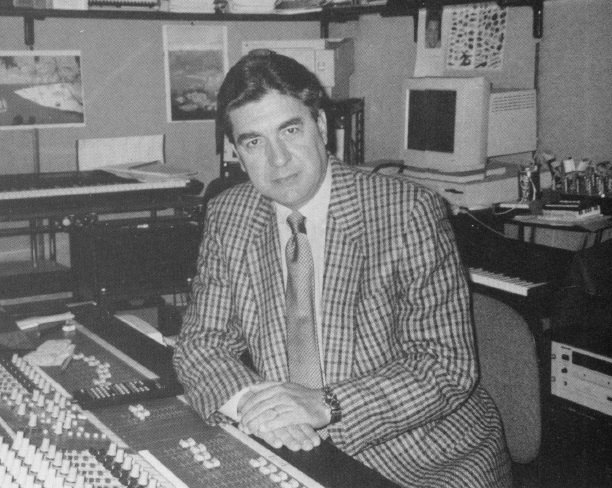
Like so many composers of film scores that were active in Italy during the late 1960s and through the ’70s, Franco Micalizzi was initiated into the film music industry by scoring a western. “My first soundtrack was ‘The Gunmen of the Ave Maria. I collaborated with Roberto Pregadio on this score, and later other movies such as ‘I due volti della paura’ and ‘Trinity’ followed.” It would be correct to say that it was Micalizzi's score for ‘Lo chiomavana trinita’ (1970) that really brought the composer to the attention of soundtrack enthusiasts, and the theme song was a considerable success in the Italian hit parade. “The big composers at that time were not really interested in ‘Trinita’. This kind of western was a new idea, and its success was in doubt, people were not sure if the mix of comedy in an Italian western would be accepted by cinema audiences. I had the luck to know the producer of ‘Trinita’, who was Italo Zingarelli, he decided to give me a big chance and let me compose the score. The idea to use a song on the main credits of the film was really a joint decision. E.B. Clucher (Enzo Barnboni), who was the director, Iralo Zingarelli and myself discussed the matter and all agreed that a song was needed. The English lyrics were written by a very good friend of mine, Lally Stott (who unfortunately disappeared in a boating accident in Liverpool.) Lally understood perfectly what I wanted to achieve with the song. “
It's surprising that although Micalizzi's score for the first “Trinita” movie was successful that he was not involved on any of the sequels. “When the ‘Trinita’ score was finished and recorded, there was unfortunately a little misunderstanding between myself and Italo Zingarelli, this was over a publishing matter. This upset lessened our friendship and I think this is why I was not asked to score any of the other ‘Trinita’ movies. I am glad to say that this misunderstanding has now been resolved and our collaboration has begun once again, which is better late than never, as they say.”
Two important figures in Italian film music are Alessandro Alessandroni and Edda dell'Orso. Micalizzi has worked with both of these talented individuals. “To work with Edda dell'Orso is extraordinary; her voice and her great talent are unique in creating a sensual and lyrical atmosphere.”
The very distinctive theme for “The Gunmen of the Ave Maria” has recently been used on many advertisements on television and also as background score on a number of television programs. Franco Micalizzi enjoyed a little limelight with the very emotional score for “The Last Snows of Spring”, but apart from this soundtrack there are not many of the composer's works available on LP or CD. Was there any reason for this? “I do not know of any particular reason why my scores were not issued in other countries; probably it is because the music publishers outside of Italy were not that interested in making soundtrack albums at the time. The only tracks of mine that [know have been made available on compact disc are ‘Stridulum’ (“The Visitor’) on RCA, and ‘Lucrezia Giovane’ on Beat. During the past two years or so I have dedicated myself to writing and also to producing many pieces of music for the Ariola Music Library. This consists of 60 CDs and I am now producing with my own company New Tea Music, a splendid music library of which there are already 8 compact discs released, with others in production.”
Does he own all of the material that he writes for them, and is he the owner of the scores that he wrote for the cinema? “The owner of the music that I wrote from time to time for the cinema is normally the musical publisher, who finances the film soundtrack. Sometimes the film studio can also be the owner of the copyright, but this is quite a rare occurrence in Italy.”
What made him decide to take up a career in writing music for film? “I always had a great love for music, and a big interest in films. Cinema was a very important source of culture for the people of my generation. I think my fascination for films and also for the music I heard in them was the reason that I was attracted towards the composition of film soundtracks. The idea of writing musical themes to accompany the film captured my imagination and fascinated me immediately.” So he did not come from a family that had a background in music? “No, it was not a tradition in my family for the son to be a musician, although I showed an interest for the subject at a very early age. I could only devote myself to study music privately, and this was only at the end of my education at high school. I gained most of my musical knowledge by my own personal experience and also by studying the work of other important musicians.”
Franco Micalizzi has composed the scores for many types of movies but he definitely seems to excel in films that call for a very romantic and lyrical score, such as in “The Last Snows of Spring”, “The White Horses of August”, “The Tree with Pink Leaves”, and the hauntingly beautiful “Alla mis cara mamma nel giorno del suo compleanno’, in which he uses a children's choir, lush strings and he exquisite voice of Edda dell'Orso. I asked him if he was more at home scoring one particular type of movie. “The beauty of writing music for the cinema is really that you get the opportunity to deal with different genres of film each time – dramas, comedies, westerns, romances... Every genre has its own stimulating opportunity for the musician. I don't think that there is one particular type of movie that is more easy or difficult to work on. The real problem is to find the right solution for every film, the correct idea for the music on any film is always difficult to find and this requires work, concentration and of course talent. I am happy to work on any kind of movie.”
When interviewing other composers, a point that is often raised is the lack of time that is allowed to score a movie... “Normally, here in Italy when a film producer or director asks a composer to write a score, the composer asks when it has to be ready, to which the producer replies, ‘Yesterday!’ This gives you an idea of how much time we have to complete a score. Every film has its own time limit. The producer or director will probably discuss what he wants for the film over a period of time, and this period is sometimes longer than the actual time that he gives the composer to write the score...! At times I have been given only ten days to complete a score, from start of writing to actual recording. I am of the opinion that the best collaborations are when the composer is given an idea of the film before shooting has begun. The composer should be given the screenplay to study; on certain occasions the director may wanta tape of a theme to be played whilst a scene is being filmed. This helps create the atmosphere, itis helpful to the actors and also the director.”
During the period when the Italian western was popular, many composers, actors and directors from Italy adopted other names, to make the film more acceptable to English and American audiences. In “A Fistful of Dollars”, Sergio Leone became Bob Robertson and Ennio Morricone became Dan Savio. Mario Girotti became Terence Hill and Carlo Pedersdi was christened Bud Spencer. I asked Franco Micalizzi whether he had ever composed any scores under a pseudonym. “No, I have never desired to do this, although many composers have. I always signed all my scores with my own name, irrespective of whether they were good or not so good.”
The question of orchestration comes into interviews frequently, especially now when composers are under increasing pressures to meet deadlines. Did Micalizzi orchestrate his own scores? “I orchestrate all of my compositions myself. I think that the orchestral colors are an important part of the composition, and for this reason I could never charge anybody else to do this refined work. At one time I used to work out my scores on the piano, but nowadays, like so many composers, I sit by my computer. Every age places the best instruments at a musician's disposal, but since everybody knows that the only really important thing is the original idea, it does not really matter how you arrive at the end product. Without ideas, no synthesizers or computers can be useful.”
Has he ever been musically influenced by composers or particular styles? “I was very influenced by jazz in all its forms, and by romantic Russian composers. Finally I was influenced by my colleagues such as Ennio Morricone, Armando Trovajoli and Piero Piccioni, who haveall been great points of reference for me.”
Does he find it helpful for the movie to be temp-tracked? “I don't really like those directors who at the first screening track the film with contemporary music which is borrowed from other films or from records. In these situations the music is no longer the fountain of inspiration as it rightfully should be, but instead the atmosphere suggests the music. In my opinion the use of a temp track on a movie is just about the most destructive thing that anybody can do to the film composer.”
Are you working on anything for the cinema at the moment? “As I have said already, I am now dedicated to recording the Cobra Music library, which is taking up a large amount of my time. In Italy the cinema industry is having a tough time because of the development of television channels. TV has sunk the great Italian cinema. I hope however that new Italian laws may soon balance the development of these forms of art and entertainment.”
Special thanks to Luciana De Gemini and Renais Reeves.