McCarthy is joined by GNP record label employees. He discusses the use of the iconic "Trek" theme and the overall importance of melody to make the music work.
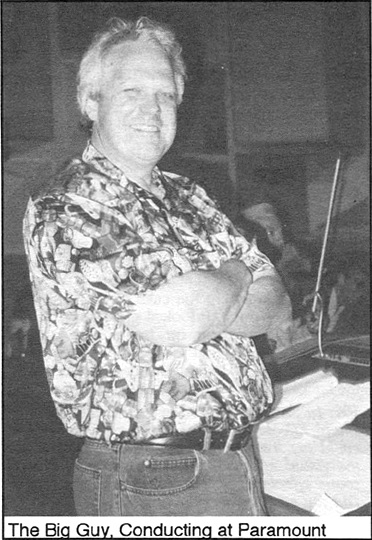
If Dennis McCarthy comes off as a big, happy, enthusiastic guy, that’s because that’s what he is – instantly loveable. He’s the perfect television composer – good at everything, incredibly fast, but always good-natured and ready to do what is asked. He conducts with whatever pen he is using and turn the most tense recording session into a jovial, fast-moving affair. Working on the current “Star Trek” television shows since “The Next Generation” began in 1987, he has sadly gotten a bad rap from fans for writing the type of subdued, non-thematic music the producers want. Fortunately, he was rewarded with his first feature assignment on last year’s “Star Trek: Generations”, and while his score is still in the mold of producer Rick Berman (last minute sound mixing toned down several cues and replaced one with music from elsewhere in the picture), it is much bigger, louder, and better than anything he was allowed to do on TV. Dennis has a lovely family (his wife Patty sat in on this interview and lent chuckles throughout) and Burbank home and I wish him the best.
This interview was held live on Peter Kelly’s “SilverScore: The Soundtrack Show of the Silver Screen” on November 23, 1994; the program airs every Wednesday in Los Angeles on KXLU radio 88.9FM from 10-11PM. Also present were Neil Norman and Mark Banning of GNP/Crescendo (ph: 213-656-2614; 8400 Sunset Bldv, Hollywood CA 90069, free catalog), the record label which has issued a dozen “Star Trek” albums by now. Neil and Mark are big fans and have worked hard to get this music available – the delays between albums are due to tricky licensing with Paramount and their desire to do elaborate packaging. Due to “Generations’s” last-minute reshoots, scoring went as late as October 28th (the film opening November 18th) and they rushed to get the “Generation” album out ASAP complete with a chromium art cover (whatever). – Lukas Kendall
“Star Trek” is one of the biggest series to come out of television – we have seen seven major theatrical releases as well. Dennis, as a composer, do you want to include the original Alexander Courage theme music quite often in your television and fil scores, or do you like to expand, writing new space frontier music keeping within the elements of the genre?
Dennis McCarthy: Actually, it’s a combination of all of those things. I really do like the Alexander Courage fanfare, I have always been a great fan of that musically. In “Generations”, I first looked through the script and said, “Ah, this is one of those spots… here’s another one… ah, here’s a third one.” Now, let me just ask up front, some people haven’t seen the film, should I be careful about giving plot secrets away?
Mark Banning: I think anyone that hasn’t seen the film would have seen it on the Internet by now. There’s nothing to hide at this time…
DM: Yeah, I know! I told the office when they first wanted to send the script, “You don’t have to send me the script – it’s already here!” But, as far as themes go, I love that theme and I used that for what were the more seminal moments of the film. I also write three separate and distinct themes myself which I used in other areas and for other purposes. But when it’s the big ships taking off, boy, I want to hear that Courage fanfare. To me that is “Star Trek” and very important.
I saw the film the first time this afternoon…
Neil Norman: How’d you like it?
I thought it was a crowd-pleaser. Very entertaining. The most fun was watching Data go a little looney. I think it worked well; there were no problems with the comedy in “Generations”. Did you ever want to write circus-like music for this change in character? Or is this just Data…
DM: It’s just Data doing his thing. As a matter of fact, the director David Carson and myself had some discussion about this subject and we decided as we had pretty much done in “The Next Generation” that comedy is comedy and it generally plays by itself, so you back up a little bit with the music. Occasionally, we’ll hit it right on the head, but I like letting the comedy play as it is. Going back to the sea ship, the “SS Hornblower” as they called it, there were some comedic moments between Riker and Geordi. However, there was an incident where Captain Picard had obviously seen a message that was very, very troubling to him. David and I had quite a talk about this. You know, they’re being funny here, but I felt we had to let the audience know that what has happened to Picard was so wrenching and so heartbreaking, we must continue this thought through, even though there was humor playing on the screen. So, while Geordi and Riker are laughing and yelling about all this nautical terminology, we kept playing the music of Captain Picard and his message, all the way through until Picard walks through the bridge and goes to his ready room. As far as Data’s humor is went, I played it from Geordi’s perspective when they were in the “secret room” where they found the trilithium-loaded space probes. While Data was being extremely funny in that scene, you know, he was statring to lose it, he was going into that lunatic thing, but I felt it was more important to let the audience know that, along with Geordi, something was amiss. This wasn’t just humor in remembering the jokes from the “Farpoint” mission… there was really something going on here that was not 100% correct…
MR: Data was really going over the top in a couple of spots. You could just see the look in Geordi’s eyes, “I gotta get that chip outta him…”
There were a number of characters that were going through changes and experiencing deep emotions like that.
DM: Oh, yeah.
The music, whether there be none or some, really intensified those experiences. There were some very quiet moments in the film…
DM: Yes, for instance Captain Picard and Troi when he was telling her what the message was. When David Carson and Rick Berman and myself looked at the scene, we took a look at each and agreed that the scene played so beautifully with nothing, so that’s what we decided to go with – it was a conscious decision.
[There were, however, two scenes in the film where Carson insisted in no music – the stellar cartography scene and Picard’s first flight with Soran – which could have been helped by cues. At this point we have a music break, and along with other cues listen to “Kirk Saves the Day.” As we listen, Dennis comments about writing that cue during a lunch break.]
You wrote that during lunch?
DM: Yeah, that was one of the first cues I did on the show. First I did the opening main title which took a couple of weeks, believe it or not. I had to figure out the themes and touch on them in that main title, etc. Well, we got to the section where Kirk saves the day – you know, he goes down, does the amazing things with the deflector shield and all that stuff. Anyway, what had happened was I got the cue, put it on the stand, kicked off the downbeat and about five bars into it said, “I don’t like this.” It was just one of those things where I heard it and I thought, “Okay, I haven’t quite settled into my groove yet.” It was the first action cue I had written for the show. We had been in the session for two and a half house and we had a full day (which is six hours for recording plus one hour for lunch) and I asked, “How about an early lunch? This would be a wonderful time so sit on the veranda and have a little mai-tai and enjoy ourselves.” We called lunch and I told everyone to go have their mai-tais. I went to the copyist room. I figured I had an hour and ten minutes for lunch, so I took the first 17 minutes and rewrote the entire cue. The ability to do this comes from old television training – speed was of the essence and still is to this day on television. “What is missing in this cue?” The answer is melody! For various and sundry reasons, it didn’t have anywhere near enough melody, so I completely rewrote the brass, basically rewrote the strings, took the woodwinds out and said, “Thank you boys, go take a rest for two minutes until I bring you back in.” The copyist, Bob Bornstein was there and by the time lunch was over, he had the cue completely rewritten for 95 players – totally recopied!
That’s a lot to eat for lunch…
DM: It’s a long cue, what does it run, three and a half minutes? Something like that…
NN: Yeah, 3:13…
DM: We hit the downbeat and it was like, “Yes, that’s much more like it.” So, we were all very happy. It’s fun to get that kind of panic going. You know, Kirk saves the day, but Dennis has got to save the cue! And it’s right now, darlin’s!
NN: I was really impressed with the entire “Star Tre”k crew and how they kept refining the movie. We saw a rough composer’s cut and thought it was a pretty good movie. By the end, I was going, “Wow, this is killer!”
DM: The re-shoot was wonderful.
I heard it was very pressed for time…
DM: Oh, but it had to be done. It simply had to be done. I saw the first cut with the original ending [Soran shoots Kirk in the back, Picard then shoots Soran –LK] and I said [sucking in a gulp of air] “Okay.” And then somebody said we’re re-shooting and I went, “Aaaah.” I could exhale! It’s like the “Kirk Saves the Day” cue I wrote: sometimes you put all your heart and soul into something and then you kick that downbeat off and think, “Whoops.” In the case of the film it was the same thing. It looked great on paper, blah blah blah, got on the screen and “whoops.” We’re glad the rest of the movie looked so good – Paramount decided to put the bucks into it and make this one a winner.
In the science fiction genre, there are sound effects and orchestral crescendos, one cuold say. They could both be used to maximize the visual effect. Certain directors like using sound effects more than orchestral crescendos. Did you get into any rumbles over this?
DM: No, not at all. It was a very smooth and pleasant process. Jim Wolvington, the sound effects guy on the film, worked with me on the television shows. He and I have known each other for years – the stuff he does is brilliant. Jim and I talked at the beginning of the process and I asked him, “When you have something specifically you feel is going to get in the face of the music, let me hear it. If I’m going to do something that I think might affect what you have to do, I’ll let you know.” As it turned out (out of instinct after seven years of working together), we really kept out of each other’s way. There are three places in the film that come to mind: the Klingon ship, Dr. Soran’s rocket exploding, and there’s the… well, actually I cheated on the planet exploding. So there’s two places where I felt, oh, and there’s also the saucer crash!
That was the big one!
DM: A big one! My feeling on that is like trying to score underneath a helicopter! It can be done, but short of using the ‘Ride of the Valkyries’, it is a little rough. Anyway, what we did was I would take it up to the point of impact, or explosion, and then I just shut the orchestra off. Period. We would build up the climax – as much as 95 guys playing their hands and chops as much as they could, then we’d just stop… and then I’d sit back and say, “Jim, over to you…”
MB: That’s one thing this film has been good for – the fact that the music and sound effects work in synchronicity with each other as opposed to trying to complete against one another.
DM: Well, Jim’s six foot four…
MB: Yeah, we have met Jim and he’s definitely someone I would not run into as eagerly as I would want to run into a gaggle of Klingons. [Editor’s note – this is the first and last stupid “Star Trek” joke you will ever see in FSM.]
NN: Really, we have recognized this early on. The sound effects are very important – it is wonderful when they work in harmony. As a matter of fact, this compact disc contains a complete library of sound effects [yours for $13.99 –LK].
MB: What you are hearing right now… [the ambience of the Enterprise-B bridge plays in the background, from the track on the CD]
DM: I didn’t know about all this. This is the first time I had seen the album – it was sitting here just before we walked in tonight. As I say, guys in Alabama rollin’ ’em out like hotcakes.
MR: We got them here from Huntsville at warp factor nine. [D’oh! What did I just say? – LK]
NN: This “Generations” album also has the first chromium album cover in history! We enjoy “Star Trek” so much we like to give people as many bonuses as possible.
Cool. Let’s break for a moment and listen to some of the music from “Generations”. This next cue, ‘Jumping the Ravine’, is taken from a scene in the Nexus world…
DM: Yeah, this scene is the first time when the theme I had developed for the two captains really gets the full statement. Captain Kirk jumps the ravine on his horse – it is a very heroic, wonderful thing. He gets to the end of the jump and he looks back in a kind of quizzical look, like “What is wrong with this picture?” So, he goes back and he jumps it again. He turns around and, once again, is really perplexed. With the music, I had to make the huge vista music as he jumps the ravine, but as he stops, the music had to stop – it had to be a little pensive with him. When he makes the second jump, it is not quite as glorious. You don’t really see this in the visuals too much, so David Carson and I discussed this and I said, “You know, what I’ll do is I’ll bring down the level of the music, so it’s not quite as heroic the second time and I’ll add the voices, which are the identifying musical idiom of the Nexus.” So, I added just a touch of the voices to let the audience know that what we are seeing is fantasy – what we are seeing is not real…
[We listen to the cue.]
A beautiful piece of music.
MB: [in the character’s voice we all know] This rules, Beavis!
DM: Yo Mark! You have been watching too much late night TV…
Dennis has composed music for “Deep Space Nine”, “The Next Generation”, not to mention a lot of other television shows like V. Shall we go on?
DM: Actually, what’s funny is that Mark and Neil I know what I have done better than I know what I have done! Trust us, it’s a lot of stuff…
MB: … he’s had scores done for the new “Twilight Zone” that CBS ran in 1985, other series work like “Mancuso FBI”, “Life Stories”, “Island Sun”…
DM: Yo Mark!
MB: It’s like I’m the walking encyclopedia here… “Sworn to Silence”, “Daddy”, “Leona Hemsley”, “Parker Lewis”. There’s a new upcoming telefilm and series called “Sliders”, a mid-season replacement due to air in January.
NN: Paramount just told me this week that GNP/Crescendo will have the rights to “Voyager”, the new “Star Trek” series – I’m sure Dennis will get dragged into that as well.
Dragged into that, huh…
DM: Yes, right.
MB: Well, the “Star Trek” continues on with Dennis. He is back doing “Deep Space Nine”.
So, Dennis, is this pretty much what you do now? Are you The “Star Trek” Composer?
DM: Well, it sure seems to have turned out that way. I couldn’t have fallen into a better trap. It’s great because I get to work with an orchestra on everything – even on the television episodes I get to use 40+ musicians…
Which is not your normal…
DM: Very unusual in this day of tight budgets and the three-synthesizers-in-a-garage scores, which we’ve all had to experience. It’s very generous of Paramount and the “Star Trek” people to budget for this type of an orchestra for an ongoing series. Very unusual.
[We proceed to give away the first Dennis McCarthy CD to a lucky 17th caller.]
Dennis, you worked with Alex North?
DM: I sure did! I did “Wise Blood” with him. We took the Tennessee Waltz and just had our way with it. Working with Alex was great – we worked together for two years. He was a great teacher. I learned an awful lot from him… on attitude! I hate to use a hackneyed phrase like that, but it’s really true. How to approach a project, etc. Alex was brilliant. I miss him a lot.
Your work on this whole “Star Trek” thing started with the pilot for “The Next Generation” series: “Encounter at Farpoint.”
DM: Rick Berman and Bob Justman knew of my work on V and also the “Twilight Zones”. Coupled with the “MacGyver ”work – I worked on “MacGyver” for, whew, seven years, I should be 95 by now – so basically, Paramount knew me from those series. The first thing they asked me to do as sort of a test was to combine the Alexander Courage television theme and the Jerry Goldsmith theatrical theme to make an opening for “The Next Generation”. I sat with George [Doerling], my crazed guitar player buddy, we went to his little studio, put it together, and there it was.
So, the next set of music will begin with music glued together by Dennis McCarthy…
MB: Super glues has such wonderful uses. 1001 uses, now 1002.
[We play music from “Next Generation” and give away a signed “Next Generation” box set.]
Neil and Mark, from the perspective of running the “‘Star Trek’ Label,” in which of the hundreds of “Star Trek” episodes are the best scores found, and how do you decide which to release?
NN: First of all, we look for the episodes that are dramatically strong like “Yesterday’s Enterprise.” We try to look for something where the music and the drama is fantastic.
MB: With “Next Generation”, each episode has its own individual score, unlike the days of classic “Trek” when they had a series of cues that were tracked and reused time and time again. They’re not really allowed to do that anymore, so people nowadays have to think of a certain episode they liked the most in which the music stood out.
NN: One the slate now, we’re coming out with “Voyager” probably on February 1. After that, we’ll do three more discs from “Next Generation” – one by Dennis, one by Jay Chattaway, and one by Ron Jones. So, we’ll have a second killer box set. Then we’ll stop and reflect there.
MB: Listeners take heart – the music “Trek” will continue…
Dennis, I don’t know if you have been keeping chalk marks of every episode you have done… quite a few?
DM: How many have I done? Do you know, Mark?
MB: Well, I know you’ve put in about 80 hours plus between “Next Generation” and of course Deep Space Nine… and it’s not over yet!
DM: I must have done nearly 100 episodes, don’t you think?
NN: I’ve seen big scrape marks in his dungeon.
DM: Yeah, right! On the piano’s leg!
[The second signed “Generations” CD is awarded to the lucky 10th caller.]
Going back to “Deep Space Nine”: Dennis, what about “Cucumbers in Space”?
DM: Oh, it’s one of my favorites!
MB: I wrote this down in the liner notes as a favorite on the Ferengi top 40.
DM: This piece of source music is found in a Ferengi bar. Of course, we’re trying to think ahead hundreds of years from now, what the music be like if I had a nauseous green drink in front of me in a Ferengi bar! One of the little secrets about “Star Trek” – I also use part of my band from “Parker Lewis” or “Mancuso” that perform the funk or rap or rock things that we do. So, we had a little fun and this was what we came up with – actually used in the show!
MB: You have to think, with ears like Ferengi, what kind of music would they like?
DM: And a brain like a cucumber!
[We listen to ‘Cucumbers in Space’, from the “Deep Space Nine” pilot album, “The Emissary.”]
Going back to using the Alexander Courage theme in “Generations”: I noted that there are not a lot of obvious points in the film when you incorporated this original theme.
DM: Well, I’m really sneaky with it. I used it about eight or ten times. What I did was I would weave it in very subtly every now and then, just touching on things like when Captain Kirk first looks at the chair as he looks around the ship for the first time… when Kirk dies…
Oh, Kirk dies?
DM: Whoops, you didn’t hear that, no one heard that!
NN: Everyone knows in “Star Trek” anything is possible. He could come back. Spock died and came back. All you have to do is go in a time warp and go back and get him.
MB: Death is not an absolute in “Star Trek”.
Well, not only did he die, but he died twice!
DM: That’s right. The first time, if you noticed, I did not use the Courage theme. I did that on purpose. I figured that a true Trekker would notice that I did not use the “Star Trek” theme. That was a tip-off, a subtle little hint to people that really watched the show that he did not really die there. Then the second time, when those eight French horns (bless their heart) come swelling up out of the strings, you know, oh, darlin’…
Wow, I didn’t catch that. Pretty sneaky.
NN: Now let’s go to music from “Star Trek: The Next Generation” composed by Dennis. This cue is from “Yesterday’s Enterprise” called ‘Klingons/Skin of Teeth’.
DM: Well, if I would have known you were going to put it on the album, I would have given you a better title!
NN: I know! A lot of the titles the composers give are just…
DM: “5m3” and stuff like that!
NN: Can you change them if you want?
DM: No, you cannot! That’s the thing. Once they are registered with ASCAP or BMI, that’s it! Some of the names are just wild. One of the cues I wrote was called ‘I Have a Gun’, which I’ll explain after the show is over… it’s a long story.
That’s very interesting, that aspect of writing. Once you have just chicken-scratched the name right on there…
DM: That’s it! Of course you just do it as an afterthought. You put down the tempo you’re gonna do, you put down the cue number, the scene that it is in, and then you have to title the thing, so you write some off-the-wall absurdity for fun and all of a sudden it is on an album in perpetuity and you think, “Gee, I kinda wish I spent more than two seconds on that one.”
But, you know, I like to think of film music as modern classical music. Look at the titles of classical pieces, it’s just “Adagio in G minor.”
DM: Sometimes Adagiato!
Now, tell me if that was not only a second of though, At least you’re giving it two seconds!
DM: Yeah, they don’t even have to think… here’s the second movement, it’s the adagio, fwoop.
[Music break, TNG’s ‘Klingons/Skin of Teeth’.]
We are coming to an end here on SilverScore. Thanks for the opportunity not only for myself, but the listeners, as well as the chance to get the music and the GNP/Crescendo out there…
NN: I’d like to congratulate Dennis on all the hard work he had done for “Star Trek” over the last seven years. He has brought a new standard of excellence to “Star Trek”.
DM: It’s been a pleasure for me, too. I really want to think you for your hard work and great efforts. Yo! I feel immortalized here!