Interview during sessions for "Hideaway". Jones mentions the importance of music communicating something which is not evident on the screen. He acknowledges that collectors may want more of his music, but that copyright and legal restrictions make it a bothersome task. He has enjoyed the range of projects he has worked on and likes the broad styles he gets to employ, particuarly since he has extensive knowledge of world music.
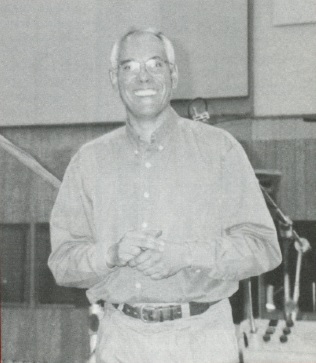
This interview was conducted in two stages. I spoke with the composer at his London base, and later on my questions were answered over the phone and by post. I would like to thank Mr. Jones for his patience and his assistance with this interview. Frankly, I feel that it was probably done at the wrong time because he has so many projects and commitments that he is working on at this moment – he has very little time for interviews. We are, after all, taking him away from his job.
Although I did ask some questions concerning films such as “Last of the Mohicans”, in one or two cases the composer’s replies were extremely short; in other cases Mr. Jones felt it would have been inappropriate to answer.
Back in the eighties, Trevor Jones came to the attention of film music enthusiasts when he composed the score for Jim Henson’s “The Dark Crystal”. It is this score that many still associate with the composer. Jones, however, has had a varied and very busy career in movie music over the past ten years, scoring films such as “Angel Heart” for Alan Parker and “The Last of the Mohicans” for Michael Mann. Last year he provided an excellent score for the box office blockbuster “Cliffhanger”, and recently he has completed two scores in Hollywood: “Hideaway” (a psychological thriller that stars Jeff Goldblum and deals with near-death experience) and “Kiss of Death” (available on Milan Records). In between scoring these two movies, Jones conducted two concerts in Finland and has recently started work on two more films, both of which are British-based productions.
This is a change for Mr. Jones, as he normally travels between Hollywood and London, working on various projects. I asked the composer how the scoring process differs between the United States and England. “I enjoy working in London and also in Los Angeles. The essential difference between the cities is that, in Los Angeles, the film business is a huge industry. There the facilities are geared towards the efficient and continual production of all aspects of film and television. In London, however, the film industry struggles against odds to exist. Facilities are few and far between and a lot of the people that are working here are up-and-coming talent. They do not necessarily have the years of experience that those in Los Angeles have. Indeed, due to negative attitude towards the financing of the industry here in the U.K., as soon as the talent in England emerges and is recognized, they leave to go to work in Los Angeles which is where the majority of the work is. In terms of the quality of the musicians that I work with – the professionalism and talent of musicians in London is excellent. This is also true of those in Los Angeles but at present the cost of the production of a score in the U.K. is still more competitive than that in Los Angeles.”
“Kiss of Death” was issued on Milan Records. “Kiss of Death” is a feature film for Twentieth-Century Fox. It is a thriller that stars David Caruso in his first film role since his success in the TV series “NYPD”. It also stars Nicolas Cage who is cast as the villain of the piece. The movie is directed by Barbet-Schroeder, who also directed “Single White Female” and “Barfly”. “For this I wrote a score that was performed by orchestra and synthesizers.”
In recent years it seems to be the fashion for record companies to release soundtrack CDs that contain very little or none of the original music that was composed for the movie. Examples of this include many of Alan Silvestri's scores and Trevor Jones has also been a victim of this process. “This happened on ‘Sweet Lies’ and on one of the ‘Arachnophobia’ CDs. The film companies sometimes hire a music supervisor and basically all he'll want to do is put out a CD of dance tracks. I do try and shy away from projects like this. It's not because the film is bad or anything like that, it's just because of the actual mechanics of the music production.”
“Hideaway” was recorded in London at the Abbey Road studios. I asked the composer about the assignment. “The ‘Hideaway’ CD has only three cues of mine on it. In total these account for over 24 minutes of original music, the remainder of the CD is made up of tracks of source music that was used in the picture. The CD was released on Mute Records in the UK and on TVT Records in the United States. The score for ‘Hideaway’ was a particularly complex work; it called for over 100 minutes of original score. It contained many different elements of music for orchestra, techno-rock, solo acoustic guitar, choir and synthesizers.”
At the sessions of “Hideaway” I noticed that Jones's assistant, Guy Dugall, actually conducted the orchestra in a type of rehearsal or dry run, then Trevor Jones took the baton and conducted the orchestra for the actual recording of the cue. Was this something that always happened at a sessions for a Trevor Jones score? “‘Hideaway’ was a very involved work, and on the technical side Tri-Star wanted to dub the film in the new Sony SDDS 8-Track System. This meant that we had 8 speakers set up in the control room of the Abbey Road Studio No.1. In addition, the director, Brett Leonard, who was unable to attend the recording sessions, had approved all the cues in sketch form. So I had my assistant rehearse a cue with the orchestra whilst I reviewed the cue that I had just recorded, along with engineer John Richards. This allowed us to check all the technical aspects of the recording, at the same time maximising the use of the studio and the musicians’ time. For me to conduct the final takes meant that I could fine-tune the performances based on what I and the director had discussed previously.”
At the sessions of “Hideaway” I was present when Mr. Jones was recording the sequence where Jeff Goldblum experiences a near-death moment; he crosses over into the other side and is then revived by doctors. The special effects in this sequence are very impressive and quite spectacular, and Trevor Jones scored this sequence with very lush, sumptuous music that I would describe as romantic-sounding. I asked him why he decided to score it this way. “To score a particular scene in a field away from the visual context of the scene can bring out a dimension of the film that goes beyond the immediate visual portrayal of that particular scene. The near-death experience is one of the spirit being released from the physical world towards a beautiful, alluring ‘other’ world. It is neither body-bound nor action-bound, hence the music I wrote that you describe as romantic-sounding.” I must say that this worked wonderfully and I think that the music for this particular sequence is a highly emotional piece.
Earlier this year, Trevor Jones journeyed to Finland to give two concerts at the Oulo festival. There were many conflicting stories around that a CD was to be issued of the concerts. I asked the composer what had become of this particular release. “Milan Records were going to do something about releasing a CD of the Oulo concerts, but due to some hitches on copyright clearance on the orchestral suites, this project has now been cancelled.” Did he enjoy giving concerts of his film music? “I enjoyed doing the festival. It's a chance to concentrate on just the music, and one tries to make this as enjoyable an experience as possible. I love to score motion pictures and it's often very hard to take out just the themes from a film score for a concert.”
Trevor Jones is quite well-represented on CD when you compare him to other composers that work in film. A good percentage of his scores are now available on disc apart from maybe the one that collectors really want to have in their collection: “The Dark Crystal”. I asked the composer if there might be a possibility of this and some of his earlier works, like “Last Place on Earth”, being issued on CD with extra cues. “I think that if I was to start up a recording label tomorrow, it would not be a problem to fill up the first twenty releases with scores that have not been issued. The master tapes for all of my movies do exist; I have them here, they are all recorded in digital sound. I think there are about 2000 tapes in this building, among them there are a number that I love and I know that many collectors would really like to see them issued. As for ‘The Dark Crystal’, when you do a score you get paid for doing that work, and that is it. From that moment on, whomever owns the copyright on the music is the one who decides whether or not people will get to hear it. This whole thing is rather complicated, so I tend to let our legal department deal with things such as this. Finding out what particular piece of music is being played by whom and being used for what is a full-time job, very involved and complicated. For instance, I was in the United States a while ago and they were using some of the music from ‘The Last of the Mohicans’ for a campaign; to try and get royalties for this would probably be impossible, so in cases like that we normally let it go. There is not much one can really do about it. Although one would think that in the computer age keeping track of who is playing whose music should be relatively easy. Frankly I think it's inexcusable for composers to be ignored in this way.”
Did he keep his scores after the recording sessions were finished? “Yes, like the tapes there are a number stored in this building. Our company is very particular about this. Everything is collected up at the end of a recording session; the pages are then collated and sent off to the binders. The reason for this is that I need a system so that I can locate the score. If I'm asked to provide a particular sound or a cue in the same style for a future assignment – for instance, a director may say to me, ‘I like that cue in “Cliffhanger”; I want something in that style’ – it's easy for me to go back and look at the score for reference.”
On “Hideaway” Mr. Jones used Larry Ashmore and Geoff Alexander as his orchestrators. Did he always use orchestrators or did he sometimes do the work himself? “I like to do very detailed orchestrations, and my orchestrators are always saying to me, ‘Why don't you get a copyist?’ I basically feel the need to look after every black dot. After all, this is my sound, my voice, and the colors and the instrumentation I choose to express them are very fundamental to the feelings that I am trying to get across to the audience. At times I find that the score is so detailed that I sit down and print out exactly what I want; I then take it to the orchestrator and ask him, ‘How can you make this sound better?’ The orchestrators do have a say in the orchestration; for instance, if I think that the suggestion is in keeping with the particular sound that I am aiming for on any of the scores, and it would enhance the picture, then normally we go ahead and use the idea.”
Many composers that work in the cinema like to become involved early on. I asked Mr. Jones when he normally becomes involved in the process. “At times I am sent a script, which I read, then try to forget it completely if I can. Because by the time the film has been completed, the script has probably gone through so many changes and been re-written many times, so by the time I get to see the rough cut I would probably be wondering if it was the same project or not! I prefer to come in when the film is put together before the final editing, anything more detailed than this is really a waste of time for me.”
At one time I can remember Trevor Jones telling me that he had been offered seven projects. With so many movies on offer, had he ever accepted a film only to discover that mid-way through he really did not want to be involved with the picture? “No, I have never been in that position. I normally only accept a project if I am 100 % sure that I want to work on it. The commitment on my part is total. I can't think of a project that I did not get pleasure out of. When I agree to do a score I am very aware of the fact that it is not just myself that I am committing, but also the whole company, the engineers, the assistants, etc.”
What happened on “Chains of Gold”? “‘Chains of Gold’ was made by an independent Australian company. I scored it about 5 years ago now. It was a strange project, and had John Travolta in the starring role. The company went bankrupt and consequently I did not receive my fee. The company went into liquidation and was taken over by the receiver; the movie finally made it out on video, but the video did not give me a credit, so I still have not been paid.”
The subject of temp tracks on movies has provoked some varying responses from composers. I put the question about a temp track to Trevor Jones. Did he find them helpful or distracting? “It is often helpful when the director has had the film temped with music, as it can be used as a guide to where music might work in a film, and also as a starting point for discussion of what sort of music might be needed. A temp track is only restricting when the director, producer or studio becomes overly obsessed with a particular piece of music, to the exclusion of all other musical possibilities.”
How many times would he normally watch a movie before getting any ideas on the music? “As long as it takes and as many times as is necessary. I can sometimes sit through the picture just once and have ideas immediately, and I don't have to watch it again. Other times I cycle the video machine and can watch individual scenes hundreds of times. I watch a film as many times as I need to.” Does it help to go on location? “I have been on location a number of times. I was on set for ‘Excalibur’ because they needed some recorded music whilst filming certain scenes. I have been winched down by helicopter and also been on board ship, playing piano, I have also been to Pinewood Studios to look at rushes; it is sometimes helpful in the development of the score.”
I asked Mr. Jones how he began in the business... “I think it all started for me when I was very young. I was about five or maybe six years of age. There was a cinema just across the street from where I lived. I came from a family that had a theatrical background and I would often see my aunts and uncles in films at the cinema; they used to appear in some of the J. Arthur Rank productions. I can remember coming back from the cinema one day and telling my mother that I was going to write music for movies. Even at that early age, I had made up my mind. Later I won a scholarship at the Royal Academy of Music, where I studied for 4 years. I was trained in composition, orchestration, and also conducting. After I completed my studies at the Academy, I went to work for the BBC. It was my job there to listen to a vast amount of music and it was while I was at the BBC that I came into contact with Wilfred Mellors. He was a professor of music at that time, this was at York University. Wilfred and I sat down and designed a Master of Arts course on film and media music. He was a great mentor. The course included ethnic music such as Indian, Javanese, and Balinese. I spent a total of 12 years studying in various places such as the National Film School. Whilst there I scored around 20 movies, which were student projects. This was a wonderful opportunity to get first-hand experience of putting music to film. My work at the National Film School it made it easier for me to go into the film industry proper.” At the National Film School Trevor Jones scored a movie called “The Dollar Bottom” which won an Oscar: “I got together with some other people to make ‘The Dollar Bottom’. I think I used about 4 musicians on this project.”
“Thankfully, I seemed to go from one picture to another after film school. I have not had many lulls, except ones that I have taken voluntarily to just go and relax.”
Trevor Jones has worked with many distinguished directors and recording artists such as Jim Henson, David Bowie, Mick Jagger, Alan Parker, and so on. I asked him about his involvement with “The Dark Crystal”. “This project came about quite a few years before the movie was actually produced. In fact, I don't think that Jim Henson had even got a script when we first discussed the movie. Jim and I were friends, and we just sat having lunch one day talking about the possibility of doing this project together. It turned out to be ‘The Dark Crystal’. The same can be said about ‘Labyrinth’. After the success of ‘The Dark Crystal’ we were returning home from the States, and Jim said to me that we should really be thinking about another movie, possibly in the same style. Of course ‘Labyrinth’ was a fantasy fairy tale, but the difference was that it also had actors and actresses in it. We were very fortunate to get David Bowie to take the lead, he was absolutely marvellous to work with. The songs on the score were his and I included some of that material in the fabric of the musical score. He truly deserves the status that he has been given by so many people.”
It is not very often that we see Trevor Jones with a credit reading “Composed and Conducted”. Was there a particular reason for this? “I do conduct occasionally, but to be perfectly honest I do tend to try not to do so. When one is working on a picture the movie is constantly changing; most films are chopped here and there. Sometimes things can change in a movie in a matter of minutes or even seconds. This normally happens when you have just got the all the timings just right and you think that it's going to look and sound great. So I might be working all though the night on something, finish at, say, 6 o'clock in the morning, and have to be at the recording studio at ten o'clock that same morning to speak with and work with 100 musicians. This is really not a good thing for anybody. A conductor is really someone who comes in and has the ability to talk with the orchestra, they have to be able to communicate with the musicians and relay to them what is required of them during the session. Everything in front of them is meticulously laid out. So by using a conductor it leaves me free to listen to the cues, and if something is not working I can tell the conductor what I want and he in turn can go back to the orchestra and relay to them what needs to be done. By using a conductor I am also able to be precise about what I expect out of the orchestra. I am really only concerned about what comes out of the speakers, and that the music works with and for the movie.”
Have there been any musical influences early on in his career? “Stylistically my scores change to suit each particular project. ‘The Dark Crystal’ and ‘The Last of the Mohicans’ were both symphonic scores that had different styles, and ‘Cliffhanger’ again was a large symphonic work; however ‘Sea of Love’ had jazz influences, because that is the style that was required for that picture. I must say that I am not aware of any composer in particular influencing me.”
With such a busy schedule, did he have time to relax and maybe go to the cinema? “I still go to the cinema and I enjoy the movie if it's entertaining, irrespective of who's scored it. However, subconsciously I sometimes think, “Well, the composer would have done better if he had put that there or the other way round...” I tend to be very objective when looking at other people's work. I enjoy going to the cinema immensely, the big screen, the popcorn, the magical moment when the house lights dim and the fanfare for the opening logo is heard, the curtains part... From that moment on, anything is possible. I get a thrill from going to the cinema and if I was to lose this, I think that I would stop doing what I am doing now.”