Goldsmith talks about how his father's work naturally created his own career. He lists all of the fellow film composers whom he admires, but snubs "Jamie" Horner. He cites "The Untouchables" as a show that has been particularly gratifying to work on.
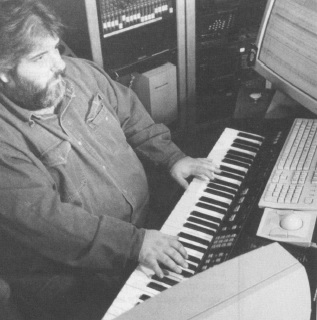


It was towards the end of my week in Los Angeles when my meeting with Joel Goldsmith was to finally take place. I was looking forward to our meeting for several reasons, but mostly because we shared something in common; we were both sons trying to live up to the expectations of our fathers, and the people in our respective industries, who held our parents in such high esteem. While my father is not in the music business, my real life job is running an eyeglass store with him. Previously, he was in the lens manufacturing business and garnered quite a reputation. So every time I meet others in this business, they inevitably ask about my father and tell me what a wonderful businessman he is. Without a doubt, Joel has experienced the same, though probably worse, since many fans have elevated his father to the status of legend.
It was late on Friday, the 17th of June 1994, that I was invited out to Goldmore Studios, Joel’s own private recording facility adjacent to his home. He told me to look for a boat parked on a trailer outside the house. Had he mentioned it was named ‘SHPILKES’, I would have had an easier time finding it. When I finally arrived, I discovered Joel, his wife, and his two assistants in front of the television absorbed in a breaking news report. “OJ.’s bolted. I’m sorry, but I gotta watch this!” he said, waving me to a place on the sofa. Even the death of Henry Mancini was lost in the wake of the town’s morbid curiosity as one of their own was suspect. Hollywood is never boring.
Before we began the interview, Joel wanted to know about me. Fair enough. I told him about my years at Starlog Magazine as associate editor in the early 1980s, and how I’d become their resident music expert when I started to freelance. To my surprise, I discovered Joel not only knew of my work for Starlog (he is apparently an avid reader), but my interview with Leonard Rosenman in #172 (November 1991) had become something of an underground classic in the Hollywood film music community. Joel was so impressed that I “allowed him to put his foot in his mouth” that he personally sent copies out. Even his father had read the piece and been impressed! I was floating so high at that moment I would have given money to a Jehovah’s Witness! Luckily, none came to the door.
In all fairness to Leonard, though I found him to be a very nice person, he had the most amazing air of bitterness when it came to the people he had worked with and his fellow composers. Joel may have felt that I had allowed Rosenman to put his foot in his mouth, but I did all I could to keep it from coming out of his ass. I was particularly taken aback by Rosenman’s lack of respect for the work of fellow “Robocop” composer Basil Poledouris, especially as I had been friends with Basil for several years and greatly admired the man’s work. When I interviewed him after “Robocop 3” for Starlog #196, Basil graciously refused the opportunity to comment on Rosenman’s score or his critical jabs. “Basil Poledouris is a fucking genius! Now we got that down in print!” Joel insisted on saying the minute I turned my tape recorder on. That was to set the tone for what I discovered would be a stimulating and surprising conversation.
I think I can dispense with my standard first question, “Did you come from a musical family?” That’s kind of obvious.
One of my sisters is very musical.
Was your father’s work what attracted you to get into film music as opposed to the other career opportunities the industry offered?
Yes, of course. What it came down to was that I always have been a big music fan. We got all the demo records for the Academy Awards. They weren’t sending out what they do today, these incredible promo packages, but we always got the records for the eligible scores and my father gave them to me. I would also get his records. So, of the 30 to 50 albums I had, half were soundtracks. All my favorite records were always soundtrack records, that’s really how I first got interested.
You went through the usual formal training?
No, I did not finish at all. I’ve always dreamed of going back, but at this point my studies are pretty much limited to on the job training. It seems that on every show I learn so much. As far as orchestration, I do study formally, still.
Did you start in TV or features?
I started actually in sound recording. I was a production mixer. I did a lot of films for Charlie Band which was how I first got into scoring. I was mixing on a film and I told Charlie I had come up with the theme for “Laserblast” (1978). I took him backstage to a piano and I improvised a theme on the spot and he said, “That’s pretty good. I’ll tell you what; I’ll let you do it with my brother, Richard.” So, Ricky and I were together, and this was the early days of electronics. We borrowed a couple of keyboards from Chris Stone and booked a recording studio. Ricky Band and I sat down and wrote it out, which is something that doesn’t happen in electronic scores very often. We sat in Ricky’s apartment for two weeks and wrote the whole score out and then went into the recording studio. One of the classic, greatest science fiction scores ever recorded! We both lost our ‘virginity’ on that show; it was quite an experience. We had a great time.
Did you endeavor to specialize in synthesizers after that?
Well, I got into electronics early because my father was into it. By the time that he did “The Reincarnation of Peter Proud” (1975), I was getting interested in electronics and was helping him out a bit. I was showing my face a lot at recording sessions and, hence, meeting people from those films. I was able to become a production mixer, which led me to become an engineer in a recording studio, which allowed me the opportunity to explore more with electronic music.
You were credited with being the programmer on the early synthesizer scores of your father…
Yeah, depending on whether you liked the electronics or not, it would be a generous credit or a misnomer because my father is very detailed with his sounds. I would not come up with the sound for him; it’s all in his mind. What I did was take care of all the logistics for a show like “Runaway” (1984). It was such a nightmare at that time trying to do an all-electronic score. There was such a huge set-up, I was there trying to keep everything running, keep the patching going. I did a lot of drum programming for his score and would do things like that. As far as the sounds, he came up with them. Every part has a specific sound. Many other composers might ask the keyboard players, “What do you think for this part?” but my father is very specific in detail. He’s always been like that.
Did you do any performing on “Runaway”?
Drums. I did the percussion programming.
Did your father have any other players?
Mike Lange and Alan Pasqua played as well.
So you had an ensemble instead of one person multi-trading?
No, it was one person at a time. There was never an ensemble, it was always overdubbing. It was basically sequenced and then he’d bring in people to perform the stuff that was technically so demanding that it was easier for a great keyboardist to play.
That wasn’t the first all synth score that you were involved with?
No, I did THE “The Man with Two Brains” a year earlier and that was all synth. “Laserblast” was all synth and there were a few others. “Crystal Heart” was a combination of electronic and acoustic… actually; there were a couple of nice pieces in that film. There is an actual record release of “Crystal Heart” on RCA. It’s a foreign release.
So you became known primarily for your synth work early on?
Yes. “Moon 44” (1990) was my first genuine orchestral score with the Graunke Symphony Orchestra (now The Munich Symphony Orchestra), which was very exciting.
Who chose the Graunke? You?
Well, it was a German production, so everything was leaning towards there anyway and Paul Talkington made it very attractive to go and record with that orchestra. He broke his butt to make it work for us.
Was it your first time recording overseas?
Yes. It was a really nice experience working with the orchestra and Chris Stone did a wonderful job orchestrating and conducting, although I did conduct the main title. I was terrified, but I had a great time. That was the first time I had officially conducted. Since then I’ve been doing a lot more of it.
I heard the picture was originally much longer when you scored it and then they re-cut it for release. It did seem a bit choppy at times.
Yes. They re-shot the beginning. To be honest, I got about fifteen minutes into the final version and was so humiliated as to what they had done to the music that I couldn’t watch it anymore. I was very proud of the final dub when we finished, but then they went in, re-cut the film, and changed everything. All of a sudden, there’s a cue from the end of the film at the beginning of the film. There’s a fight scene that never existed before that they tracked with, what I thought, was an inappropriate piece of music. It’s the composer’s lament, which you hear us whine all the time. I had actually said to the producers, “Finish your cut. I will go in, and I will re-edit the music with my editor or, I will rescore it electronically to tie things together. Let me polish it.” It was simply that they didn’t want to pop for the price of a plane ticket for me to go over and supervise things. So instead of paying $600 or $700, they basically took and hatched up what I had done.
But that story’s no worse than what any other composer in town has. Maybe it hurt more because it was my first full orchestral score.
You did get an album out of it!
Yeah, thanks to Ford Thaxton.
Were you pleased with it? Albums never sound the same as when you’re on the recording stage.
That’s true. In general, yes, I’m happy with it, though it would have been great if there had been more time to write. Given the time and the schedule we had, I thought Chris did a terrific job with the orchestra. All said and done, we should be proud. I’m just so happy Christopher Young backed off the project! I’ll always have a debt of thanks to him. I think he is a good composer as well. It would have been interesting to see what he would have done with the film.
For TV, you did the “Hollister” pilot score and your father did the main title. Was that an assignment he turned down?
I was doing “Moon 44” and they hired my father to do the theme for “Help”. Richard Kraft came up with the idea of my doing the underscore on the pilot. Then we went to series, and it was a short-lived series. What had happened on “Hollister” was that someone else was hired to do the score and it didn’t work out. Fred Lyle, who I’ve just finished a show with, wanted Jerry Goldsmith to do the score. He couldn’t do it, but he agreed to do the theme. Fred had heard a tape of mine from before and remembered what we did on “Help”. He asked my father if we would do that again and my father said, “Sure.” My father was obviously more than happy to do it that way and it worked out pretty well. It was a fun show, though nobody ever saw it. But it was my first experience to work with Fred. I worked with him on “The Untouchables”, which was a joyous experience. The best working environment I’ve ever been in.
What other TV have you done?
Rod Taylor hired me to do Pat Morita’s “O’Hara” series toward the end. I did half of the last season, writing a new main title for the show and scoring about 12 episodes. It was my first actual series, other than some ghosting work, which I prefer not to mention. I then did “Help” and “Hollister” for Universal. Then came “The Untouchables”, which was the same team. At the beginning there was talk of my father doing the theme to both “Deep Space Nine” and “The Untouchables”, with me doing the underscore to the latter. They were very enthusiastic about that idea. My father, because of his busy schedule, had to bail on the entire thing, and that’s when Chris Crowe, the executive producer, and Fred Lyle, the producer on “The Untouchables”, decided to give me the whole thing. It was really a nice thing and it made me feel really great. It would have been devastating to lose the job because my dad bailed. Instead he bailed out and I got the whole thing which was really flattering and a great experience.
You got to do a style of music different than what you had done previously.
Jazz. Lots of jazz.
The pilot had an orchestra, but not the series?
The pilot we did with about 40 players, which my father, by the way, conducted. He was very sweet about the whole thing. I had written it and Jack Skew was gonna conduct the pilot. He’s a terrific orchestrator and a real pro. I said to my dad, half-jokingly, “Well, gee, why don’t you come in and conduct the main title?” He asked when we were recording and said, “Well, we’ll see.” Up until the day before we did it, he hadn’t committed and the morning of the session he just showed up! He walked in and said, “You want me to do it?” I told him I wasn’t sure we could afford him! So he said he’d do it for scale and I said, “Go ahead!”
And this was in front of all the Paramount execs. It was kinda nice. It was very sweet. We had a couple of small disagreements, but nothing we couldn’t work out. That was really a thrill. He did the first date, the title and a couple of cues, and then after lunch he went home and Jack did the rest of the stuff.
Did Jack do the rest of the series?
No, I did the rest of it with a small ensemble, anywhere between 6 and 10 people sometimes. The first season I did here in this studio, bringing in guys individually. Then the second season we recorded at an outside studio where I also conducted. It worked out real well.
Did you emulate acoustic instruments with synthesizers?
We did it carefully. Anything that was gonna be exposed I used a real instrument.
You also did a lot of ethnic themes for Capone and stories like the Cuba 2-part episode.
It was exciting; a composer’s dream. Every week you didn’t know what were gonna throw at you. I had the use of the Paramount research department, and Bob Bornstein. If I needed any kind of reference material, Bob would send it over.
What would he send, scores, tapes?
We were doing a show with Billy Holliday-type stuff. I called Bob and asked, “Bob, what do you know about Billy Holliday?” and two hours later Bob had sent me sheet music of songs and a couple of CDs. The support that Paramount gives you, David Grossman and that whole team over there, makes you feel like you’re a king.
“The Untouchables” had a lot of shows that required specific musical motifs. The Louisiana Killer show, the Hillbilly show…
That last one was easier because a lot of my roots are in Appalachian music. That came easier, Billy Holliday took more work. The music department, it’s one of those old-time music departments that you just don’t see anymore. The staff is so good and they want to help you as much as they can. It’s a dream for any composer. I’m sure Dennis McCarthy and Jay Chattaway (“Star Trek: Deep Space Nine”) feel the same way.
I also had a great music editor on the show, Steve Danforth, who is incredibly knowledgeable about music, as well as architecture. We did 42 episodes and I’m very anxious to go back to work for them. We’re doing another series in the fall.
There was a rumor about “The Untouchables” going onto Paramount’s new network with “Star Trek: Voyager”.
No. They’re talking about a mini-series, which Crowe told me they might do. Crowe’s doing “The Watcher”, an anthology series for the new United Paramount Network that I’m scoring.
Did you find it difficult writing a new score week after week?
It really got to be a grind sometimes and they gave me the opportunity to take a break, if I wanted, but it seemed every time I really needed one, we’d get two weeks off, anyway. I wasn’t the only person working week after week and we were spotting the shows pretty heavy. All of the scores were up in the mid-20 minute range, whereas a “Star Trek” episode will have 11, 12 minutes. We had 33 minutes on one show, which is a lot of music on a 44-minute show!
It was a grind, sure, but for a youngish composer, learning his craft, which I anticipate doing for my entire career, it’s wonderful. Being so prolific forces you into a whole other approach for writing, which is basically instinctual.
Chris Stone and I once talked to Beethoven on a Ouija Board and asked for his advice on writing and his reply, in German, was, “Go with your instincts.”
I’ve asked this question to everyone this week, is film scoring changing for the better or for worse?
Well, both. In general, I think it’s for the worse. I mean for one, it seems everyone who has a Casio keyboard is a film composer. Technology has made it so anyone, for a very small investment, can have a tape that sounds real good. And because of that, a director will very often use his friend who’s a composer of some sorts to do his show. Sometimes it works out great, sometimes it doesn’t. Film composing is a lot different than song writing. It’s an art in itself. It’s very technical in many ways and it’s a complete compromise. It’s difficult for me to sit down and write a piece of music when I don’t know that it’s supposed to be 3 minutes and 14.6 seconds long. The boundaries that are set for composers in film scoring are terrific. These days it seems like anybody can do it.
There’s this crop of younger composers who are incredible. Wonderful stuff is coming out. There’s tremendous talent out there, but there’s so much product that there’s a tremendous amount of dreck, some of which I’ve been responsible for, myself!
Ten years ago, a composer like myself could make a good, comfortable living doing independent features, ‘B’ movies. The budgets were always $20,000 to $25,000. You could do a simple electronic score with a small ensemble. Now the budget for an independent, small feature is $5,000 or $6,000. There’s no room for using acoustic instruments, live musicians, unless you play it yourself. The time frames are very short and the attitude of the producers is that they don’t care. They’ve made their money with presales and they just need something finished. Believe it or not, there’s a lot of competition for a $6,000 movie! I’m thanking my lucky stars I’m not in that frenzy right now. I may have just missed it, but I have friends, talented composers, who are fighting for a $6,000 score!
I hear stories from my father about the old days, where for a $4,000 budget on a “Twilight Zone”, he would write for, and record with, four guys. Well, if you want to write a score using four guys, your chops better be good. It’s a lot harder to write for four men than 80 men.
I remember when I did “Moon 44”, I was panicking before recording. I phoned my father and sent him some sketches and after a while I think he got a little annoyed with my referring to him. He’s a busy man and he said, “You want to know what the bottom line is? You put 80 men up there, you have them play ‘Twinkle, Twinkle, Little Star’ and it’s gonna sound amazing!” And it’s true! That’s not the way it was in the old days.
Today you can simulate a symphony orchestra in the studio. The compositional skills today are not what they had to be in the old days. You can do so much today with textures and the impact of the sounds themselves.
You definitely get the sense with some synth composers that they make it up as they go along. Others, like Chuck Chirino and Richard Band stand out because their work sounds like it was thought out and carefully orchestrated.
Well, having been in the Jim Wynorski stable myself I’d have to say Jim demands that of his composers like Chuck. Whether you’ve seen a Jim Wynorski film or not and whatever you think of them, he is no push-over and Jim Wynorski is no dummy. He knows what he wants and he comes in and has you do some re-writes. He wants melodies, he wants themes. I was surprised when I worked with Jim. I was a little cocky at first because I had no idea he was as knowledgeable as he is. I worked on the TV movie “Little Miss Millions”, a USA cable Christmas special with Howard Hessman. He was no push-over. He had a vision, which was a lot more than many directors I’ve worked with. Some composers, though, can improvise. Chris Stone is brilliant at it.
There are artificial intelligence programs right now that can write music for you. You play the melody and it’ll do the accompaniment. The “Hummers” are surrounding themselves with electronic gear and are doing wonders with it. Who’s to say? Some of these guys are not untalented.
Danny Elfman, when he wrote the first BATMAN, was rumored to have found that the orchestra session didn’t sound quite the way he had envisioned it would when he wrote the music in his own studio.
Danny Elfman, listen to Oingo Bongo, I think he’s terrific. I’ve always felt he’s been kind of overrated by the public and underrated by his peers. “Pee Wee’s Big Adventure” and “Beetlejuice” were two great scores. Very Oingo Boingo-esque. You know, that isn’t Shirley Walker doing “Beetlejuice”, it’s definitely his personality. He’s a very modest guy about his writing.
Are there other composers you favor?
I like a lot of James Newton Howard’s stuff. I like Jerry. I like John Williams a lot. His mastery of the craft sometimes leaves me in awe. I was a big fan of Alex North, Bernard Herrmann, Franz Waxman, and Alfred Newman. Ford sent me the soundtrack to “How the West was Won”. What a great score. The music Elmer Bernstein wrote for “The Magnificent Seven”, spectacular. Forget the Malboro Cigarette theme! And “To Kill a Mockingbird”!
What would be your dream film, whose score demands would really get your adrenalin pumping?
A really great love story. An “Out of Africa”. John Barry did such a beautiful job. Maybe a little action, too.
A love story with a train wreck?
Sure. A love story with a train wreck. A really good train wreck! Every movie I do, be it a Jim Wynorski film or TV show, I’m always looking for the sentimental aspect of it.
“Untouchables” did give you a lot of that.
There were a few episodes that I’m very proud of as far as the relationships or love stories, though most of the shows tended to be whiskey wars.
Your favorite episode score?
Show #014, when Pagano falls in love with a woman and she ends up going off at the end. There were some nice opportunities for music there.
Do you ever think we’ll see an album of the music?
Boy, there’s been a lot of talk about that. It’s down to the point where the musicians have agreed to cut a deal for it. We’ll see what happens, but I doubt it.
I understand Paramount put all the scores on CD?
They archive everything on CD. That’s how they archive now. It’s a handy reference thing. I suppose one day they’ll be bootlegged. I had no idea there was such a tremendous bootleg market on CDs. I see on the computer information lines people are bootlegging the one my dad did for the Society for the Preservation of Film Music. People are willing to spend a lot of money for it.
I saw a “Greystoke” CD for $150. I love John Scott, but not that much!
Why didn’t John Scott take off? Haven’t you wondered about that? Why didn’t John Scott become a big time film composer? That baffles me more than the no-talents getting these big movies. They’re flash-in-the-pans. There’s no longevity there. But why didn’t Sandy Courage or Arthur Morton become big time composers? Arthur wrote the theme to the TV show PEYTON PLACE, and Sandy, of course, “Star Trek”. Why didn’t John Corigliano do more than two movies?
I heard he really doesn’t want to be a film composer.
Well, isn’t that ironic? “Altered States” is one of my favorite scores.
Elliot Goldenthal seems to have the same desire as Corigliano, to do more concert composing than film.
Someone once asked Aaron Copeland why he didn’t do more film scores and Copeland replied, “Because nobody asked!” That’s a frightening thought.
John Scott’s doing another horror film.
Probably be fucking great, you know that? So much of it baffles me. All these real talents in ruts.
Craig Safan fell off the face of the earth. He was hot in the early 1980s, did “Cheers”, and then disappeared!
He’s probably in Hawaii laughing at us.
Actually, he was spotted on Martha’s Vineyard last summer! Robert Folk is also back doing comedies like “In the Army Now” and another “Police Academy”…
Larry Rosenthal never caught on big.
He just did “Young Indiana Jones” with Joel McNeely, and got an Emmy award for the episode ‘Ireland 1916’.
I’m interested in seeing what happens with Cliff Eidelman. He’s really on the rise. Had some good opportunities. I hear he has the real Bernard Herrmann temperament. That worked for Jamie Homer. You see, I’m a real fan; I’m not a Jamie Homer basher. I like him.
Don Davis feels the same way about Horner, but I feel you can’t escape the fact that during some brilliant score, he’s gonna drop in a cue that’s been copied verbatim from an earlier work.
Who knows? The guy’s working so much, who’s to say. He did “48 Hrs.”, which I thought was a really good score, and then a couple of others that sounded exactly like it. He went through his shakauhachi phase and so on. So what? He’s a human being.
There’s only one thing that bothers me about Jamie Homer, and I always call him Jamie because it annoys him. He dated my sister in High School, Oakwood. I would go to my dad’s sessions and Jamie would be there. He was always at my Dad’s sessions. My dad recognised his talent and promoted him on some things and gave him some breaks and stuff like that. Probably for three or four years, at every session Jamie was there. And I could never understand, I’ve read some of his interviews, when he’s asked about his influences, he’s never once, ever, acknowledged my father in the inception of his career. My dad did take him under his wing for quite a while.
We’re all influenced by Jerry Goldsmith. Jamie’s been accused of it more than others, but I’ve never understood his not acknowledging my father’s help at the start of his career. He let Jamie have scores and come to sessions, which a lot of up and coming composers would like to do, hang out at a Jerry Goldsmith session. I’ve always meant to ask him that, but the opportunity has never arisen.
I was an assistant engineer on Jamie’s first TV movie. Maybe he was afraid of people making too much out of that Jerry Goldsmith connection. We’ve all helped ourselves to Jerry and any of the other stuff we listen to. We’re all influenced by it. I remember my father watching “Def-Con 4” and commenting on Chris Young’s score, “My, he did help himself to ‘Planet of the Apes’” and I said, “Who hasn’t?” God knows, I have.
It’s funny, your father, I guess, got a little revenge by helping himself to “Conan the Barbarian” for the “Total Recall” main title.
Is it really Poledouris? I didn’t know that. Technically, “Total Recall” is a total masterpiece, but I don’t think it is the best thing my father’s done. I think “Basic Instinct” is one of his most recent best works. Certainly the most poignant.
And then there’s Michael Kamen, great on film but not always on disc.
He makes sure it works on film. Well, he was just writing so much at one point, what did he do, 12 films in one year?!
He had 15 orchestrators on “Robin Hood”…
He took out an ad in Variety because they didn’t give all those guys credit at the end of the movie. I thought it was a classy thing to do. David Newman’s carved quite a niche for himself, though I prefer his brother Thomas. “The Player” was terrific, as were “Scent of a Woman” and “Men Don’t Leave”. Funny how David just took off. Just rocketed.
I hear you’ve got an anthology album coming out?
I’m putting something out on Prometheus. It is a collection that will include the music from “Job Man”, the score I’m most proud of. It was a small South African film which, if you can believe it, never even got on cable, and they’ll put anything on cable! I really liked a lot of what I did. The director was very helpful and I had a great time on the show. Maybe it’ll also have some of “Man’s Best Friend”.
Besides the Chris Crowe show, “The Watcher”, what else are you currently involved on?
Right now I’m doing the MTV show “Dead at 21”. There’s very little underscore, though, mostly pop songs. I’m also working on the new Stephen J. Cannell show, “Hawkeye”, based on James Fenimore Cooper’s novel The Last of the Mohicans.
By now it had gotten late and, with O.J. now off the freeway and the road opened, I was free to leave. Joel, who had told me earlier in the week that his schedule was tight, had given me much more time than I had hoped for. We enjoyed our talk so much that my 1 hour interview had gone on for almost 3. He was hungry to get back to work, and I was just plain hungry. I thanked him for his hospitality and drove off, hoping that, like the Newman brothers, he would also get a chance to carve his own niche outside his father’s shadow. Sometimes we sons have to stick together.